
First Time Deposit (FTD) in iGaming is one of the most critical early-stage metrics because it marks the exact moment a registered user becomes a paying player. Until a deposit happens, acquisition performance remains incomplete. FTD represents the transition from intent to real monetary value.
For iGaming operators, understanding FTD is essential for evaluating acquisition quality, onboarding effectiveness, and early player behavior. It is not just a conversion milestone, but a signal of trust, readiness, and long-term potential.
What Is First Time Deposit (FTD)?
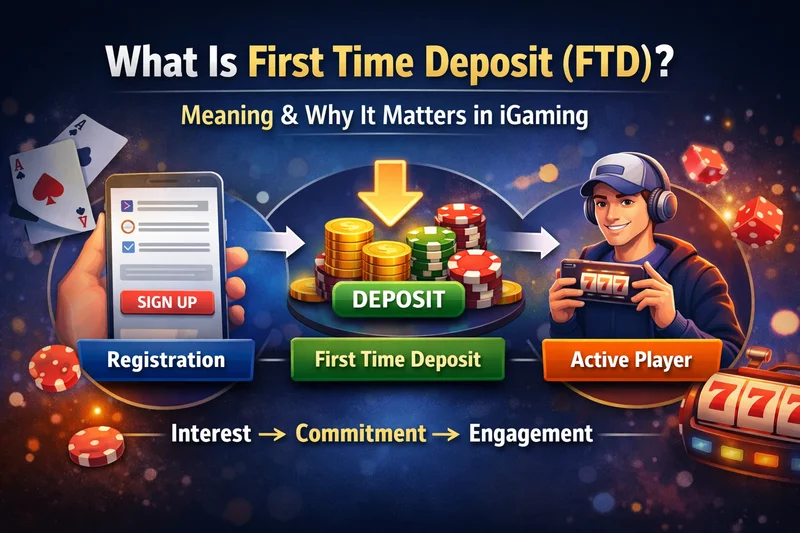
First Time Deposit (FTD) is the first successful monetary deposit made by a registered user on an iGaming platform, marking the point at which a user becomes a paying player. It is counted once per player and is typically tracked within a defined attribution window following registration.
In simple terms:
- Registration indicates interest
- FTD confirms commitment
A user who registers but never deposits is not considered an active player. FTD is the event that moves a user into the revenue lifecycle and enables meaningful performance analysis beyond sign-ups.
FTD Rate Formula
The First Time Deposit (FTD) rate is calculated as:
FTD Rate = (Number of First-Time Depositors ÷ Total Registrations) × 100
This metric measures how effectively registrations convert into paying players within a defined attribution window and is widely used to benchmark onboarding performance in iGaming.
FTD rate is typically analyzed within a defined time window following registration to ensure consistent performance measurement.
How First Time Deposit Works in iGaming
The typical FTD journey follows a clear sequence:
- A user registers on the platform
- The user explores games, bonuses, or platform features
- The user completes their first deposit
Only after the first deposit is successfully completed does the user qualify as an FTD. Until then, they remain a registered but non-depositing user.
This distinction helps operators understand where users drop off during onboarding and how effectively registration activity converts into monetization.
Time to First Deposit (FTD)
Time-to-FTD measures the duration between user registration and the first successful deposit. Shorter time-to-FTD often indicates stronger onboarding clarity, higher deposit intent, and lower friction within payment flows.
Operators monitor this metric alongside FTD rate to detect early drop-offs and onboarding inefficiencies before long-term retention behavior can be evaluated.
Why First Time Deposit Is an Important Metric
FTD is not just a conversion metric — it is a quality indicator.
A strong FTD rate usually reflects:
- Low friction during onboarding and payments
- Clear value perception for new users
- Trust in the platform at the moment of deposit
FTD is important because it measures how effectively registered users convert into paying players, making it one of the most critical acquisition and onboarding KPIs in iGaming.
Low FTD rates often signal issues such as unclear bonus conditions, trust barriers at checkout, payment friction, or unnecessary complexity in registration flows.
Because of this, FTD is widely used to assess the effectiveness of acquisition channels, marketing messages, and early user experience.
In performance-driven iGaming operations, FTD rate is frequently segmented by acquisition channel, affiliate source, geography, and payment method. This allows operators to distinguish between traffic that generates registrations and traffic that produces genuine deposit intent.
Stop Wasting Acquisition Spend on Unconverted Signups
See why top global operators use OptiKPI to automate onboarding funnels and increase First Time Deposits (FTDs) by up to 45%:
- Recover Stalled Signups: Automatically message players the moment a cashier window closes.
- Instant Smart Offers: Send custom bonus codes dynamically within 120 seconds.
- Maximize ROI Data: Track exactly which affiliate acquisition paths generate active value.
*No obligation. See a custom setup built for your gaming platform.*
Examples of How FTD Is Used in Practice
In real-world iGaming operations, FTD is rarely analyzed in isolation. It is commonly used to compare acquisition performance across campaigns, affiliates, geographies, and time periods.
For example, two campaigns may generate the same number of registrations but very different FTD volumes. In this case, FTD helps identify which campaign attracted users with genuine deposit intent rather than casual interest.
FTD trends are also monitored over time to detect onboarding issues. A sudden drop in FTD without a corresponding drop in registrations often indicates new friction introduced between sign-up and payment, such as changes in bonus terms or payment availability.
FTD as an Early Indicator of Player Quality
Players who complete a first deposit are statistically more likely to engage again than users who never deposit. For this reason, FTD is frequently analyzed alongside early churn indicators.
Tracking FTD allows operators to:
- Identify friction points before long-term engagement begins
- Understand how quickly users move from registration to value
- Gain visibility into early-stage drop-offs in the player journey
In the context of early player churn, FTD functions as a reference point rather than an isolated KPI.
How First Time Deposit Impacts Lifetime Value Forecasting
While FTD itself is a single event, it has long-term implications. Players who deposit earlier tend to:
- Engage more frequently in the first weeks
- Respond better to promotions and lifecycle messaging
- Show higher retention during the first 30–90 days
As a result, FTD data is often used in lifetime value (LTV) models to forecast revenue performance across acquisition sources and markets.
Operators do not only track how many players deposit, but also how quickly they deposit and what happens immediately after the first transaction.
Interpreting FTD in Context
Although FTD is a powerful metric, it should always be interpreted alongside related indicators. High FTD volume does not automatically mean long-term success if players fail to remain active or deposit again.
Similarly, lower FTD rates in some markets may reflect higher trust thresholds or longer decision cycles rather than poor acquisition quality. Geography, payment preferences, and player expectations all influence FTD behavior.
For this reason, experienced operators treat FTD as an early signal — not a final verdict — within a broader lifecycle measurement framework.
Where First Time Deposit Fits in the Player Journey
First Time Deposit sits at a pivotal moment in the player lifecycle:
Awareness → Registration → First Time Deposit → Retention → Loyalty
FTD acts as the gateway to measurable engagement. Once a player completes their first deposit, retention behavior, engagement patterns, and value progression can be evaluated with greater accuracy.
Understanding this position helps align acquisition analysis with retention measurement without conflating lifecycle stages.
Common Reasons Players Fail to Complete First Deposits
Many users register on iGaming platforms but never complete their first deposit. In most cases, the issue is not lack of interest — it is friction during onboarding, payments, or trust validation.
Some of the most common reasons players fail to convert into first-time depositors include:
- complicated registration flows
- payment method limitations
- unclear bonus terms
- slow KYC or verification processes
- trust concerns during checkout
- poor mobile payment experience
- lack of localized payment options
Even small friction points introduced between registration and deposit can significantly reduce FTD conversion rates.
Because of this, experienced operators continuously analyze registration-to-deposit drop-offs to identify and remove conversion barriers early in the player journey.
How Operators Improve FTD Conversion Rates
Improving First Time Deposit conversion requires more than increasing registration volume. Operators must optimize the transition between onboarding, trust-building, payment completion, and early engagement.
Common FTD optimization strategies include:
1. Simplifying Onboarding Flows
Reducing unnecessary registration steps helps players reach the deposit stage faster with less friction.
2. Improving Payment Accessibility
Supporting localized payment methods and faster transaction processing increases deposit completion rates across markets.
3. Using Real-Time CRM Triggers
Behavior-based CRM workflows can detect abandoned deposit attempts and trigger reminders, incentives, or support messages in real time.
4. Optimizing Bonus Clarity
Clear bonus communication improves trust and reduces hesitation during first deposits.
5. Personalizing Early Engagement
Operators often personalize onboarding communication based on geography, device type, acquisition source, or player behavior to improve conversion efficiency.
How CRM Automation Supports First-Time Deposit Conversion
CRM automation plays an important role in helping operators convert registered users into first-time depositors.
Modern iGaming CRM systems can automate engagement flows based on real-time player behavior, including:
- abandoned deposit reminders
- onboarding email sequences
- push notification campaigns
- bonus eligibility triggers
- payment recovery workflows
- behavioral segmentation
For example, if a player reaches the payment page but exits before completing the deposit, automated workflows can trigger reminders or alternative payment suggestions within minutes.
This allows operators to respond immediately instead of relying on delayed manual campaigns.
FTD Segmentation and Player Quality Analysis
Not all first-time depositors represent the same long-term value.
Many operators combine FTD analysis with player segmentation strategies to identify high-value players and optimize lifecycle engagement.
Operators frequently segment FTD players based on:
- acquisition source
- geography
- payment method
- deposit amount
- time-to-FTD
- early engagement behavior
This helps identify:
- high-value acquisition channels
- churn-risk players
- bonus-sensitive users
- VIP potential
- low-quality traffic sources
FTD segmentation helps operators move beyond raw deposit volume and evaluate actual player quality and retention potential.
Common Mistakes When Measuring FTD Performance
FTD is one of the most valuable early-stage metrics in iGaming, but it is often interpreted incorrectly when analyzed in isolation.
Some of the most common mistakes include:
1. Focusing Only on Registration Volume
High registration numbers do not guarantee strong monetization if deposit conversion remains weak.
2. Ignoring Time-to-FTD
Delayed deposits may indicate onboarding friction or lower purchase intent.
3. Evaluating FTD Without Retention Context
A strong FTD rate means little if players fail to remain active after the first transaction.
4. Using Inconsistent Attribution Windows
Different attribution periods can distort campaign comparisons and acquisition analysis.
5. Treating FTD as a Final KPI
FTD is an important milestone, but it is only the beginning of the player lifecycle and retention journey.
Relationship Between First Time Deposit (FTD) and Retention
First Time Deposit is not the end of the acquisition journey — it is the beginning of retention.
Players who successfully complete their first deposit are more likely to:
- engage again within the first week
- respond to onboarding campaigns
- participate in promotional journeys
- generate long-term revenue value
However, a strong FTD rate alone does not guarantee sustainable retention.
Operators also monitor:
- repeat deposit behavior
- early churn indicators
- post-FTD engagement
- session frequency
- time between deposits
This is why experienced operators treat FTD as an activation milestone within a broader player lifecycle framework rather than as an isolated acquisition KPI.
FTD vs Registration vs Conversion Rate
Registration, conversion rate, and First Time Deposit are closely related metrics, but they measure different stages of the player journey.
| Metric | What It Measures |
|---|---|
| Registration | User creates an account |
| Conversion Rate | Percentage of users completing a target action |
| FTD | First successful monetary deposit |
| Revenue Impact | Actual monetary activation |
A platform may generate high registration volume but still struggle with low FTD performance if users fail to trust the platform or complete the payment process.
Because FTD represents monetary activation rather than simple sign-up activity, it is considered one of the most important conversion metrics in iGaming operations.
Real-Time FTD Triggers and Automation
Modern iGaming platforms increasingly rely on real-time automation to improve First Time Deposit conversion rates.
Behavior-based triggers can identify when players:
- abandon payment pages
- delay deposits after registration
- repeatedly fail payment attempts
- remain inactive after onboarding
- show high purchase intent without converting
Operators can then automatically trigger:
- onboarding reminders
- personalized bonuses
- payment recovery messages
- localized payment suggestions
- push notifications and CRM workflows
This allows teams to reduce friction and improve deposit completion without relying entirely on manual intervention.
Key Takeaways
- First Time Deposit (FTD) marks the transition from registration to active monetary engagement.
- FTD is one of the most important early-stage KPIs in iGaming acquisition and onboarding analysis.
- Strong FTD performance often reflects lower onboarding friction and stronger user trust.
- FTD should always be evaluated alongside retention, engagement, and player quality metrics.
- CRM automation and behavioral triggers play a major role in improving deposit conversion rates.
- Operators increasingly use FTD segmentation and lifecycle analysis to improve long-term player value.
Conclusion
First Time Deposit is far more than a simple conversion metric. It represents the moment a registered user becomes an active participant in the revenue lifecycle.
Understanding how FTD behaves across onboarding, payments, CRM automation, and retention workflows helps operators identify friction early and improve long-term player value. Many teams also combine FTD insights with player segmentation and CRM automation to improve lifecycle performance.
As iGaming competition continues to increase, operators that optimize the transition between registration and first deposit gain a significant advantage in both acquisition efficiency and retention performance.
FTD is not just the start of monetization — it is the foundation of the player lifecycle.
Optimize Every Step Between Registration and First Deposit
Improve First Time Deposit performance with AI-powered player intelligence, real-time engagement, and CRM automation designed to increase conversion, retention, and player lifetime value.
FAQs
First Time Deposit (FTD) is the first successful deposit made by a registered user on an iGaming platform, marking the transition from registration to active play.
FTD stands for First Time Deposit. It is commonly used as an abbreviation in iGaming reporting, affiliate tracking, and performance analytics to refer to a player’s first successful deposit.
FTD shows how effectively registered users are converted into paying players and provides insight into acquisition quality and onboarding performance.
Registration indicates interest, while FTD confirms financial commitment. A user can register without depositing, but only depositing users are counted as FTDs.
No. FTD measures the first deposit event. Retention measures continued engagement after that point. FTD is an early lifecycle milestone, not a long-term engagement metric.
FTD rate specifically measures how many registered users complete their first deposit. Overall conversion rate may include other actions such as registrations or installs. Because FTD reflects monetary activation, it is considered a primary revenue conversion metric in iGaming analytics.
Related Topic
iGaming operators seeking structured approaches to increase FTD conversion and reduce registration-to-deposit drop-offs can explore our guide on improving First Time Deposit conversion.