
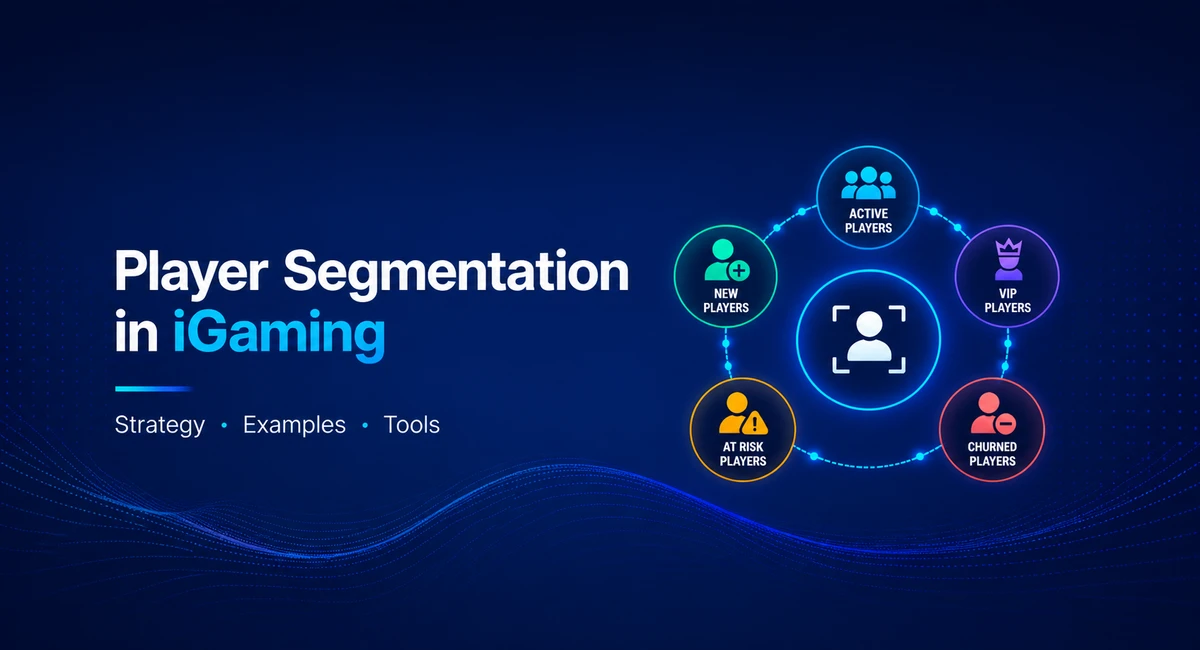
Player segmentation in iGaming is often treated as a reporting layer — age groups, locations, device types. The result? Clean dashboards but flat revenue.
Most operators miss the real opportunity: segmentation tied directly to player behavior and lifecycle triggers. That is where retention, reactivation, and player lifetime value growth actually happen.
This guide breaks down how gaming operators use behavioral data, CRM automation, predictive signals, and lifecycle segmentation to drive measurable retention and revenue outcomes.
Operators looking for broader implementation strategies can also explore customer segmentation for gaming operators.
What is player segmentation in iGaming?
Player segmentation in iGaming is the process of grouping players based on behavior, value, and lifecycle stage to enable targeted marketing and CRM actions. Effective segmentation helps operators increase retention, personalize engagement, and maximize player lifetime value through real-time campaigns and automated workflows.
How Player Segmentation Works in iGaming
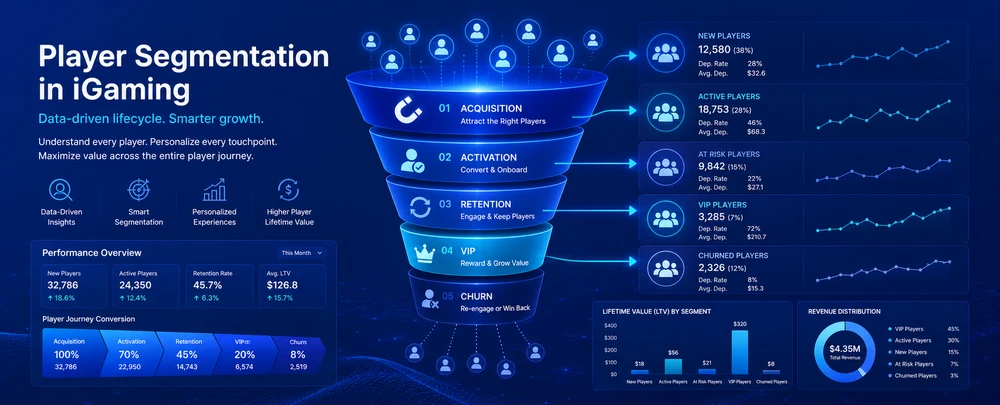
At its core, player segmentation means grouping players in order to treat them differently.
Basic segmentation includes:
- age
- location
- device type
- game preference
However, revenue-focused segmentation goes deeper into:
- deposit frequency
- session behavior
- churn signals
- bonus sensitivity
- engagement patterns
Example:
- Player A deposits regularly and logs in daily → high retention potential
- Player B deposits once and disappears after two sessions → churn risk
Treating both players the same is where revenue leakage begins.
Why Most Segmentation Strategies Fail to Drive Revenue
Most segmentation strategies fail because segmentation is disconnected from execution.
What happens:
- segments exist only in dashboards
- CRM campaigns remain generic
- no real-time triggers exist
- retention workflows stay manual
Why it happens:
- CRM and data teams operate separately
- segments are static instead of behavioral
- automation systems are disconnected
Impact:
- missed reactivation opportunities
- generic campaigns
- bonus inefficiencies
- lower retention performance
The solution is moving toward dynamic segmentation connected directly with iGaming CRM automation workflows.
According to industry retention benchmarks published by Statista, improving retention even slightly can significantly impact long-term profitability.
Core Types of Player Segmentation
Forget textbook segmentation categories. Focus on the segments that actually drive retention and revenue.
Behavioral Segmentation
- bet frequency
- deposit behavior
- session duration
- bonus usage
- game activity
Lifecycle Segmentation
- new player
- active player
- VIP player
- inactive player
- churn-risk player
Value-Based Segmentation
- low-value players
- mid-tier players
- high-value players
- VIP players
Predictive Segmentation
- early churn prediction
- deposit decline patterns
- VIP potential
- reactivation likelihood
Even small retention improvements can significantly impact long-term player lifetime value.
Behavioral Segmentation: The Key to Retention and LTV
This is where casino player segmentation becomes a real revenue lever.
Example:
A player reaches the deposit page but abandons the process.
What is happening?
- payment friction
- trust concerns
- payment method limitations
CRM action:
- trigger payment reminder
- offer alternate payment methods
- send follow-up notification
Another example:
A player is highly active for three days and suddenly disappears.
Retention response:
- trigger free spins campaign
- send personalized reactivation offer
- activate churn prevention workflow
This is where behavioral analytics in CRM becomes critical.
Behavior → Segment → CRM trigger → Revenue
High-Value Player Segments Every Operator Should Track
Not all player segments contribute equally to retention and revenue. High-performing iGaming operators prioritize behavioral and value-based segments that directly influence player lifetime value, engagement, and churn prevention.
These are some of the most important player segments every operator should actively monitor and optimize.
1. VIP Players
VIP players generate a significant share of gaming revenue through frequent deposits, higher betting activity, and long-term engagement.
Recommended actions:
- dedicated VIP managers
- exclusive bonuses and rewards
- priority support
- personalized retention campaigns
2. Churn-Risk Players
These players show declining engagement patterns such as lower deposit frequency, shorter sessions, or reduced betting activity.
Recommended actions:
- reactivation campaigns
- behavior-triggered CRM flows
- personalized retention offers
- predictive churn monitoring
3. Bonus Abusers
Bonus-sensitive players often engage only during promotional periods without contributing long-term value.
Recommended actions:
- restrict bonus eligibility
- monitor suspicious activity patterns
- apply risk-based segmentation rules
- optimize bonus spending efficiency
4. First-Time Depositors (FTDs)
Many operators lose players shortly after the first deposit due to weak onboarding and activation journeys.
Recommended actions:
- automated onboarding workflows
- early engagement campaigns
- cross-channel CRM communication
- deposit-to-retention optimization
5. High-Intent Non-Depositors
These players frequently browse games, betting markets, or payment pages but fail to complete deposits.
Recommended actions:
- payment method optimization
- trust-building communication
- localized payment support
- real-time deposit recovery triggers
Operators using behavioral analytics in CRM can identify these segments earlier and automate engagement strategies in real time.
Real Player Segmentation Examples in Casinos & Sportsbooks
Casino Example:
- segment: declining slot activity
- trigger: free spins + jackpot reminder
- result: stronger reactivation performance
Sportsbook Example:
- segment: event-driven bettors
- trigger: odds boost before major matches
- result: increased betting activity
Cross-Sell Example:
- casino player → sportsbook onboarding
- trigger: personalized first-bet campaign
Structured segmentation helps operators move players efficiently between lifecycle stages.
Player Segmentation Strategies That Work
Real-Time Segmentation
Players move dynamically between segments based on live behavior.
Example: a deposit drop instantly triggers churn-risk workflows.
Micro-Segmentation
Operators break broad segments into highly targeted behavioral groups.
Example: VIP slot players inactive for 48 hours.
Predictive Segmentation
Predictive analytics identifies future player behavior before churn occurs.
Execution depends heavily on real-time CRM and automation infrastructure.
Quick Wins vs Structural Fixes in Segmentation
Quick Wins:
- create inactivity-based churn segments
- launch retention email workflows
- separate first-time depositors from regular users
Structural Fixes:
- build real-time segmentation pipelines
- connect CRM systems with behavioral tracking
- implement predictive analytics workflows
Quick wins generate immediate gains. Structural fixes create long-term retention advantages.
Player Segmentation vs CRM Segmentation
While CRM segmentation focuses on organizing customer groups for campaigns and communication, player segmentation in iGaming goes much deeper into behavioral analysis, lifecycle tracking, betting activity, churn prediction, and real-time engagement triggers.
Modern gaming operators require segmentation systems that react dynamically to player behavior instead of relying only on static CRM lists.
| Aspect | Player Segmentation | CRM Segmentation |
|---|---|---|
| Primary Focus | Player behavior and gaming activity | Customer grouping and campaign targeting |
| Industry Usage | iGaming, sportsbook, casino platforms | General industries including retail, SaaS, and eCommerce |
| Data Sources | Bets, deposits, gameplay, sessions, retention signals | Demographics, email lists, purchase history |
| Segmentation Logic | Real-time behavioral and predictive analysis | Mostly static rule-based grouping |
| Primary KPI | Retention, LTV, churn prevention | Campaign engagement and conversions |
| Key Goal | Improve retention and player lifetime value | Improve campaign targeting efficiency |
| Real-Time Updates | Dynamic and behavior-triggered | Limited or scheduled updates |
| AI & Predictive Modeling | Frequently integrated | Often basic or absent |
| Lifecycle Tracking | VIP, churn-risk, dormant, active, high-value players | Lead and customer lifecycle stages |
| Automation Depth | Advanced trigger-based engagement workflows | Basic CRM automation workflows |
| Revenue Impact | Directly tied to retention and gaming revenue | Mainly focused on campaign performance |
| Risk Monitoring | Fraud detection, bonus abuse, responsible gaming | Rarely included |
| Personalization Level | Highly dynamic and contextual | Moderate personalization |
Effective player segmentation combines behavioral analytics, predictive intelligence, retention automation, and real-time personalization to maximize engagement and reduce churn.
Operators looking to connect segmentation directly with automation workflows should also explore iGaming CRM platform automation and behavioral analytics in CRM.
Player segmentation defines who the player is. CRM segmentation defines what action should happen next.
Tools for Player Segmentation in iGaming
Most operators use a combination of CRM systems, analytics platforms, and automation tools to manage player segmentation. However, many traditional setups create a major gap between player insight and real-time execution.
| Tool Type | Primary Purpose | Strengths | Common Limitations |
|---|---|---|---|
| CRM Platforms | Campaign execution and player communication | Email, SMS, push notifications, workflow automation | Limited behavioral intelligence and static segmentation |
| BI & Analytics Tools | Reporting and player behavior analysis | Dashboards, cohort analysis, retention tracking | Insights without direct activation or CRM execution |
| Traditional Segmentation Tools | Audience grouping and rule-based targeting | Basic player categorization and filtering | Delayed updates and limited real-time responsiveness |
| Real-Time Segmentation & Automation Platforms | Behavioral segmentation + CRM execution | Dynamic segmentation, predictive analytics, automated workflows | Requires strong data integration and real-time infrastructure |
Modern iGaming operators increasingly require platforms that combine segmentation, behavioral analytics, predictive intelligence, and CRM automation within a single execution layer.
This is where modern player segmentation software evolves beyond reporting and becomes a real-time revenue execution layer.
Instead of simply analyzing player behavior, operators can immediately trigger retention campaigns, automate lifecycle journeys, personalize engagement, and respond dynamically to churn-risk signals.
Where OptiKPI Fits
OptiKPI is not just an analytics platform. It acts as an execution layer for retention and CRM automation.
- tracks player behavior in real time
- builds dynamic player segments
- triggers CRM workflows instantly
- supports lifecycle automation
Instead of exporting reports manually, operators can react immediately to behavioral changes.
How OptiKPI Turns Segments Into Revenue Actions
- detects deposit decline → launches retention flow
- identifies VIP upgrade → activates VIP journey
- detects inactivity → triggers reactivation campaigns
- automates onboarding based on player behavior
This helps operators improve retention performance and execute campaigns faster.
Key Takeaways
- Player segmentation improves retention and CRM performance.
- Behavioral segmentation is critical for identifying player intent.
- Real-time CRM automation increases engagement speed.
- Predictive segmentation improves churn prevention.
- Execution matters more than static reporting.
Conclusion
Player segmentation in iGaming only delivers results when it is connected directly to behavior, lifecycle automation, and CRM execution.
Operators relying on static segmentation and generic campaigns miss retention and revenue opportunities daily.
The gap is not data — it is execution.
Platforms like OptiKPI help operators transform segmentation into real-time CRM actions that improve engagement, retention, and player lifetime value.
Turn Player Segments into Actionable Engagement
Transform player data into actionable segments with AI-powered insights, behavioral triggers, and CRM automation designed to improve retention, reduce churn, and maximize player lifetime value.
FAQs
Player segmentation in iGaming is grouping players based on behavior, lifecycle stage, and value to enable targeted CRM actions and improve retention and player lifetime value.
Casino operators use behavioral data such as deposits, activity, churn signals, and game preferences to trigger personalized campaigns and retention workflows.
Behavioral segmentation groups players based on deposits, betting patterns, engagement activity, and session behavior to improve retention and CRM targeting.
The most effective segmentation strategies include real-time segmentation, predictive segmentation, lifecycle segmentation, and micro-segmentation connected to CRM automation.
Operators use CRM platforms, analytics systems, behavioral tracking tools, and real-time automation platforms to manage player segmentation and engagement workflows.