Omnichannel marketing in iGaming has shifted from a competitive advantage to an operational requirement. As acquisition costs rise and player loyalty declines, operators can no longer rely on isolated campaigns or channel-specific messaging.
Modern iGaming teams must deliver connected, real-time player journeys across email, SMS, push notifications, in-app messaging, and affiliate touchpoints. When these interactions are unified through behavioral data and automation, engagement becomes timely, relevant, and measurable.
This guide explains how omnichannel marketing works in iGaming, why it is essential for retention and compliance, and how leading operators apply it in real-world scenarios to improve lifetime value and player trust.
What is omnichannel marketing in iGaming?
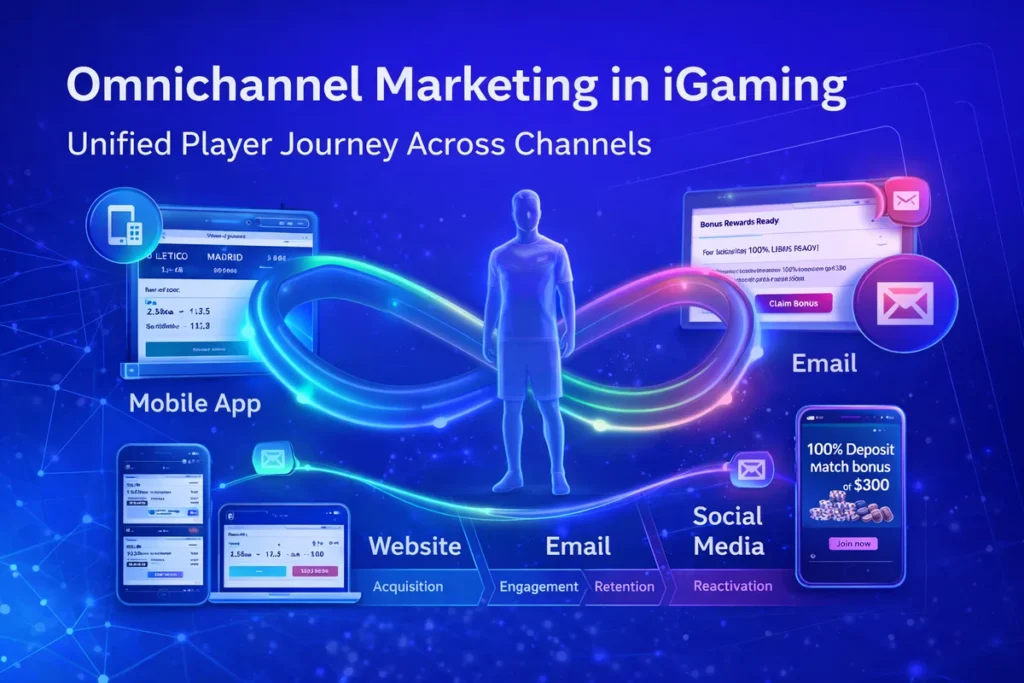
Omnichannel marketing in iGaming is a strategy that connects email, SMS, push notifications, in-app messaging, and affiliate touchpoints into a single, real-time player journey. It uses behavioral data and automation to deliver consistent, personalized engagement that improves retention, lifetime value, and regulatory compliance.
Why Omnichannel Marketing Is Essential for iGaming Operators
Real-Time, Personalized Player Engagement
Players expect seamless experiences across devices and channels. Omnichannel strategies ensure that a journey started on mobile continues on desktop with context preserved.
Competitive Advantage in Regulated Markets
As markets in the UK, EU, LATAM, and APAC mature, coordinated engagement across channels becomes a key differentiator for licensed operators.
Simplified Compliance and Responsible Gaming
Centralized communication logic helps operators enforce opt-ins, frequency caps, and responsible gaming messaging consistently across all channels.
Omnichannel vs Multichannel Marketing in iGaming
| Aspect | Multichannel | Omnichannel |
|---|---|---|
| Data | Siloed | Unified player profile |
| Messaging | Static, repetitive | Context-aware, behavioral |
| Experience | Fragmented | Seamless across channels |
| Attribution | Channel-level | Journey-level, real-time |
| Retention impact | Limited | High |
Core Pillars of an Effective Omnichannel Strategy
Centralized Player Data
All player activity—sessions, deposits, gameplay, device usage—must feed into a unified data layer.
Lifecycle-Based Personalization
Messaging adapts based on onboarding stage, engagement level, and churn risk.
Channel Synchronization
Email, SMS, push, and in-app messaging work together rather than competing for attention.
Real-Time Insights
Campaigns adjust dynamically based on live player behavior instead of delayed reports.
Key Features and Benefits for iGaming Operators
Unified Player Profile and Real-Time Data
Operators gain a single view of player behavior across platforms and devices.
Behavior-Triggered Campaigns
Actions such as inactivity, deposit abandonment, or big wins automatically trigger coordinated responses.
Personalization at Scale
Automation allows one-to-one experiences without manual campaign management.
Built-In Compliance Controls
Opt-in management, responsible gaming notifications, and jurisdictional rules are enforced consistently.
Improved ROI and Marketing Efficiency
Relevant, timely messaging reduces churn and increases lifetime value without excessive bonus spend.
Essential Omnichannel Marketing Tools for iGaming
| Tool Category | Purpose |
|---|---|
| CRM & Player Data Platforms | Centralize data and lifecycle tracking |
| Email & Push Tools | Personalized, automated communication |
| SMS & Mobile Engagement | Time-sensitive alerts and offers |
| Affiliate Data Integration | Post-conversion journey automation |
| Campaign Analytics | Measure ROI and retention impact |
Retention-focused omnichannel platforms designed specifically for iGaming combine these capabilities into a single engagement layer. Platforms such as OptiKPI exemplify this approach by enabling real-time, compliance-aware orchestration across channels without fragmenting player data or workflows.
Real-World Omnichannel Use Cases in iGaming
Bonus Conversion Sequences
A newly registered player receives an email reminder, followed by a push notification if no deposit occurs, closing the loop across devices.
VIP Engagement Workflows
High-value players are identified through session frequency and bet size, triggering tailored SMS, push, and in-app communications.
Automated Responsible Gaming Messaging
When behavioral thresholds are reached, automated RG notifications are sent across all opted-in channels to maintain compliance.
Measuring Omnichannel Success in iGaming
Key metrics include:
- Player retention and reactivation rates
- Conversion rates on offers and bonuses
- Average player lifetime value (LTV)
- Channel engagement (open and click-through rates)
- Opt-out and compliance metrics
Future Trends in iGaming Omnichannel Marketing
- AI-driven personalization and churn prediction
- Cross-device and identity-based orchestration
- Conversational in-app messaging
- Greater transparency in data usage and consent
Key Takeaways
- Omnichannel marketing is now foundational for iGaming growth
- Real-time data enables timely, relevant engagement
- Automation improves retention without increasing overhead
- Compliance must be embedded into every journey
- Unified platforms outperform fragmented tool stacks
Conclusion: Omnichannel Is the Operating System of Modern iGaming Marketing
Omnichannel marketing in iGaming has evolved beyond campaign coordination into a core operating system for player engagement and retention. When data, automation, and compliance are unified, operators gain the ability to respond to player behavior in real time, personalize experiences at scale, and maintain regulatory consistency across every touchpoint.
As competition intensifies and acquisition costs rise, fragmented tools and channel-centric strategies increasingly limit growth. Operators that succeed are those that design omnichannel journeys around retention, lifecycle intelligence, and responsible gaming, rather than isolated promotions.
In this environment, omnichannel marketing is no longer a differentiator—it is foundational infrastructure. Teams that invest in unified platforms today are better equipped to retain players, protect trust, and scale sustainably in the years ahead.
Ready to design retention-driven omnichannel journeys?
Explore how a unified iGaming CRM platform enables real-time omnichannel engagement, automation, and compliance across the entire player lifecycle.
FAQs
Email, SMS, push notifications, in-app messaging, web overlays, and affiliate touchpoints are commonly used.
It responds to player behavior in real time, delivering relevant messages at the right moment, which reduces churn and increases loyalty.
Yes, when platforms enforce opt-ins, frequency controls, and responsible gaming rules centrally.
Yes. Once players convert from affiliates, their journeys can be automated across owned channels.
Multichannel uses separate channels independently, while omnichannel connects them into a single, coordinated player journey.