
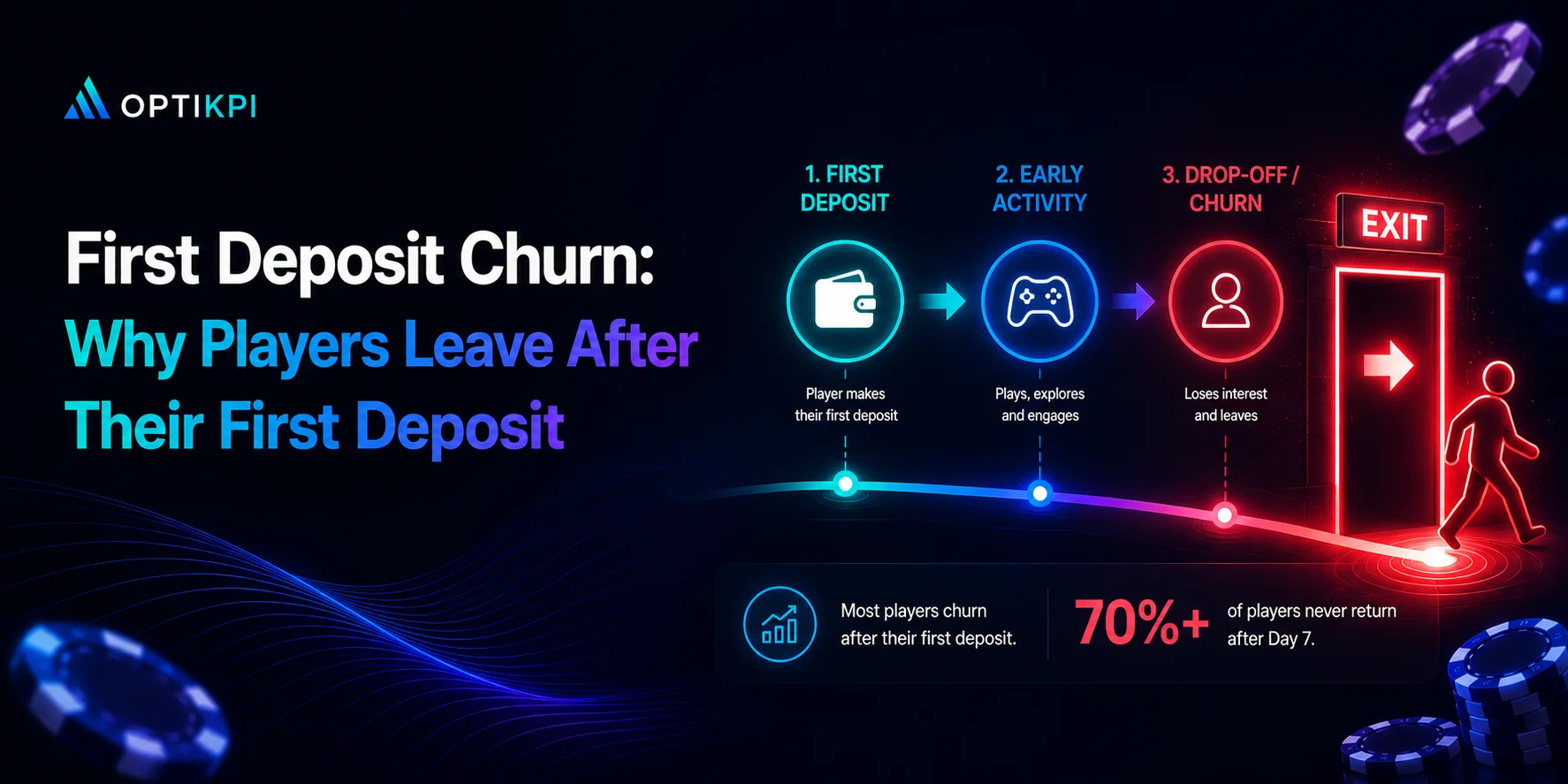
An operator can be converting registrations into first-time depositors successfully and still lose a significant share of potential player value almost immediately afterward. That is because a First-Time Deposit (FTD) is not the end of acquisition. It marks the beginning of a new retention risk period.
A player has registered, passed through the necessary acquisition funnel and committed money. But none of that guarantees a second session, a second deposit or a sustainable engagement pattern. Some newly depositing players disappear after limited gameplay. Others remain active briefly but never redeposit. Some encounter friction, disengage or simply fail to establish a reason to return.
This is first deposit churn: the loss of newly depositing players before they establish repeat-deposit or sustained engagement behavior.
For CRM and retention teams, the first 24–72 hours after FTD deserve particular attention. Instead of waiting for a one-time depositor to meet a conventional definition of dormancy, operators can observe what happens immediately after the deposit, identify combinations of behavioral warning signals and intervene while the player’s activity is still recent.
The operational objective is straightforward: move from detecting churn after it happens to recognizing post-FTD risk while there is still an opportunity to influence the next player action.
What is first deposit churn?
First deposit churn is the loss of a newly depositing player before they establish a repeat-deposit or sustained engagement pattern. It occurs after First-Time Deposit conversion but before the player progresses into a healthier repeat lifecycle, making it a distinct operational stage rather than simply another form of general player churn.
This distinction matters because several different conversion and retention problems can otherwise become mixed together.
Registration-to-FTD conversion asks whether registered players become depositors. Strategies for improving first-time deposit conversion therefore operate primarily before the first deposit.
First-deposit retention asks what happens next.
Does the new depositor play? Do they return for another session? Does their activity deepen? Do they attempt another deposit? Do they become a repeat depositor?
Later lifecycle churn is different again. It concerns players who have already established some history with the operator before their engagement declines.
Treating all three stages as a single churn or retention problem can obscure where value is actually being lost.
A completed first-time deposit proves that the player crossed one important commercial threshold. It does not prove that they have been successfully activated or retained.
For that reason, operators should measure the transition from FTD into subsequent meaningful behavior separately from both acquisition conversion and wider lifecycle retention.
Want to see how this can be managed through CRM?
Explore how OptiKPI helps operators identify early churn signals, segment players and trigger timely retention actions.
Why players churn after their first deposit
There is rarely one universal explanation for why players stop playing after their first deposit. The more useful operational question is what happened between FTD and disengagement, and whether that behavior could have been detected early enough for CRM to respond.
1. The first playing experience fails to create momentum
A deposit followed by meaningful activity represents a different lifecycle state from a deposit followed by a few minutes of interaction and an exit.
The latter does not automatically mean the player will churn. But it provides context.
A newly depositing player might browse several games without settling into one, place limited bets, play an unusually short session or stop interacting soon after depositing. If that player then fails to return, the combination becomes more informative.
The important point is not to label a short session as churn. It is to detect the progression, or lack of progression, after the FTD.
2. Bonus expectations and wagering conditions do not align
Promotions can introduce friction when what the player expects does not match what they experience.
A player may claim an offer but show little subsequent activity. Another may interact with promotional communication while displaying limited platform engagement. These behaviors can provide useful context for CRM teams.
That does not make bonuses the universal explanation for one-time depositor churn, nor does it mean another incentive is automatically the appropriate response.
Bonus behavior should be treated as one signal within a broader post-deposit behavioral picture.
3. Withdrawal friction can damage early trust
A withdrawal initiated soon after FTD can mean several things.
The player may simply have had a successful first session and decided to withdraw. Alternatively, their experience during the process may affect how they perceive the operator.
The behavior itself therefore needs context.
Rather than treating an early withdrawal as proof of churn risk, operators can examine what follows it: Does the player return? Does engagement stop abruptly? Are there interactions with support or transactional communications? Does the player continue browsing without playing?
The sequence can be more useful than the isolated event.
4. The operator fails to react to early behavioral signals
This is one of the most preventable causes of post-deposit churn.
Many CRM journeys are still structured primarily around elapsed time:
Send a welcome message after X hours. Send another communication the next day. Deliver an offer on Day 3.
Time-based journeys are operationally convenient, but two players who deposited at the same time may have behaved completely differently since then.
One might have completed three meaningful sessions.
Another might have deposited, played for four minutes and disappeared.
If both receive the same message because they occupy the same scheduled journey, CRM is ignoring some of the most relevant information available: player behavior.
5. Communication becomes irrelevant after the deposit
An FTD changes the player’s relationship with the operator.
Before depositing, the objective may have been conversion. After depositing, the question becomes what the player should do next.
Yet generic welcome journeys can continue communicating as though all FTDs represent the same lifecycle state.
Post-FTD communication becomes more relevant when it responds to context. A player who deposited but did not play has a different potential barrier from one who played extensively but has not returned, while an active player who has not made a second deposit represents another situation entirely.
6. Competitors remain part of the player’s consideration set
Players may maintain accounts with multiple operators, encounter competing promotions or simply decide another product better matches what they want.
Operators cannot control those decisions.
What they can control is how quickly they identify declining engagement on their own platform and whether their CRM response reflects the player’s recent behavior.
Competitor activity is therefore a possible explanation, but not a useful substitute for analyzing observable first-party behavioral signals.
7. The player never establishes a repeat-engagement pattern
The transition from one-time depositor to repeat player is strategically important because repeated behavior begins to establish a lifecycle pattern.
The second deposit conversion can be particularly informative, but it should not be treated as the only definition of successful progression. A meaningful return session, sustained gameplay or other operator-defined engagement event may also demonstrate healthy development.
The key question is whether the player is progressing beyond the isolated first transaction.
| Cause | Observable signal | Potential CRM response |
|---|---|---|
| Weak initial momentum | FTD followed by little activity or a very short session | Trigger context-specific follow-up based on initial activity |
| Promotion friction | Bonus claimed with little corresponding engagement | Clarify relevant next steps rather than automatically adding another incentive |
| Early withdrawal | Withdrawal followed by reduced or absent activity | Observe subsequent behavior before selecting an intervention |
| Missed behavioral signals | Significant inactivity while scheduled journey continues | Move player into a behavioral risk segment |
| Irrelevant communication | Message engagement without platform engagement | Change message context or channel based on actual behavior |
| Declining engagement | No return session after initial activity | Trigger a return-oriented intervention |
| No repeat pattern | Continued activity but no further deposit or meaningful progression | Test an appropriate progression sequence |
The operational model is Cause → Observable Behavior → Segment → Trigger → Intervention → Measurement.
That makes first deposit churn something CRM teams can work with, rather than simply report after the fact.
Why the first 24–72 hours after FTD matter
The first 24–72 hours matter because player intent and recent behavioral context are still visible. Operators can observe whether the FTD progresses into gameplay, another session or repeat deposit behavior and intervene before inactivity becomes established dormancy. This makes the period a prevention window rather than a later reactivation problem.
The exact appropriate timeframe will vary by operator, vertical and expected player cadence. The 24–72-hour window should therefore be treated as an operational framework, not a universal statistical threshold.
Its value comes from recency.
Immediately after FTD, CRM teams can ask concrete questions:
Did the player actually start playing?
How long did the first session last?
Did they return?
Did they attempt another deposit?
Did their activity increase or decay?
Did they engage with CRM communication without returning to the product?
As time passes without meaningful activity, the problem begins to change. Eventually, the operator is no longer trying to prevent early disengagement; it is trying to reactivate an already inactive player.
0–24 hours: establish what happened after the deposit
Operators should observe the immediate relationship between FTD and subsequent activity.
Relevant events may include gameplay initiation, session duration, product interaction, bonus activity, withdrawal behavior, communication engagement and deposit attempts.
The objective is observation before assumption.
A player who deposits and remains highly active should not be treated like a player who deposits and leaves immediately.
24–48 hours: identify missing progression
The absence of an expected next action begins to become more meaningful when combined with earlier behavior.
For example, a short initial session followed by no return creates a different risk profile from sustained initial engagement followed by a temporary pause.
Dynamic segmentation becomes valuable here because the player’s state can change quickly.
48–72 hours: increase intervention urgency
If a newly depositing player still shows little evidence of progression, CRM teams may want to escalate the relevance of their intervention.
The objective is not simply to send more messages.
It is to respond to the specific behavioral sequence that has occurred.
That might mean changing the message, channel, timing or incentive logic—or deliberately withholding an incentive when it is not contextually justified.
After 72 hours: prevention starts moving toward reactivation
There is no universal moment at which a player becomes dormant. Operators should define dormancy according to their own player cadence and lifecycle model.
Operationally, however, prolonged inactivity gradually moves the problem away from immediate post-FTD prevention and toward broader reducing casino churn across the wider player lifecycle and reactivation.
That distinction matters.
Waiting until a new depositor qualifies for a conventional dormant segment may mean CRM has missed the period when the player’s initial intent was most recent.
Behavioral indicators that a first-time depositor may churn
No individual behavior proves that an FTD will churn. Churn-risk detection becomes more useful when operators combine multiple signals, such as a short initial session, no return activity and no second deposit, into a behavioral risk segment that can change dynamically as new player events occur.
Potential indicators include:
- Deposit followed by little or no gameplay
- An unusually short first session relative to relevant operator benchmarks
- Abrupt session termination
- No return session within the operator’s expected early lifecycle window
- No second deposit
- Declining session frequency
- A failed or abandoned deposit attempt after FTD
- Bonus claimed with little corresponding engagement
- Withdrawal shortly after initial activity
- A significant change in game or betting interaction
- Communication engagement without platform engagement
- Repeated browsing without meaningful action
The key is combination.
Consider two players who have not made a second deposit.
Player A deposited yesterday, completed several meaningful sessions and remains active today.
Player B deposited, played briefly, has not returned in 24 hours and ignored the next contextually relevant communication.
Both technically have “FTD + no second deposit” status.
Their behavior, however, suggests different CRM needs.
Player B might enter a behavioral churn-risk segment because several signals together indicate stalled progression. Player A may simply need more time.
This is where churn prediction becomes operationally useful even without treating predictions as certainty. CRM does not need to know that a player will churn. It needs enough evidence to determine that one player currently warrants a different treatment from another.
Segmentation should happen after the deposit, not stop at the deposit
“FTD completed” is an event, not a sufficiently detailed long-term CRM segment. Once a player deposits, segmentation should continue according to what they do next so that CRM can distinguish healthy progression, friction and early disengagement.
Useful post-FTD segments might include:
- FTD + active gameplay + no second deposit: The player remains engaged, so an aggressive return message may be unnecessary. CRM can focus on progression rather than recovery.
- FTD + no gameplay: The deposit occurred without the expected product action. Communication should reflect that gap rather than assuming the player has already had a meaningful playing experience.
- FTD + short first session: This becomes more relevant when combined with no subsequent return.
- FTD + withdrawal initiated: CRM should interpret what happens next rather than assuming withdrawal itself indicates disengagement.
- FTD + bonus engagement: Bonus interaction can inform messaging, but it should be assessed alongside gameplay and deposit behavior.
- FTD + no return session within 24 hours: This creates a useful early-risk segment where the player’s previous session context can inform intervention.
- FTD + high engagement but no redeposit: This player may not be disengaged at all. CRM should distinguish deposit progression from engagement progression.
- FTD + failed second deposit attempt: This is fundamentally different from a player who showed no intention to redeposit. The failed event itself provides CRM with actionable context.
These segments should be behavioral and dynamic.
Static demographic characteristics may help enrich them, but what the player did five minutes ago can be more relevant to an immediate post-FTD intervention than a broad persona assigned during acquisition.
How operators can reduce first-deposit churn
Reducing first deposit churn requires an operational system rather than a collection of generic retention messages.
Step 1: Define the post-FTD success event
Before identifying failure, define healthy progression.
Depending on the operator and product, success might include:
- A second meaningful session
- A second deposit
- Return within a defined period
- Continued game or sportsbook engagement
- Another operator-defined activation event
The second deposit is commercially useful because it demonstrates repeat transactional behavior, but it should not automatically become the only success metric.
Step 2: Identify high-risk behaviors
Map the behavioral sequences associated with stalled progression.
Instead of simply asking whether the player redeposited, examine what happened in between.
Did they play?
Did they return?
Did they try to deposit again?
Did they interact with a promotion?
Did engagement decline?
The result should be a set of behavioral conditions that CRM can observe.
Step 3: Build dynamic segments
Post-FTD states can change rapidly.
A player in “FTD + no gameplay” might begin playing ten minutes later. Someone in “active FTD + no second deposit” may complete another deposit while a scheduled campaign is still waiting to send.
Dynamic segmentation allows players to enter and leave audiences as their behavior changes.
That prevents yesterday’s data from dictating today’s message.
Step 4: Trigger interventions based on behavior
Once segments exist, connect them to event-driven CRM.
The intervention should consider:
- Timing: How recently did the relevant behavior occur?
- Channel: Which communication channel is appropriate and permitted?
- Context: What actually happened before the trigger?
- Sequence: What should happen if the player responds or does not?
- Incentive: Is an incentive appropriate, and if so, at what point?
This is more precise than sending every FTD the same campaign after an arbitrary number of hours.
Step 5: Measure whether the intervention changes behavior
Campaign engagement is not the end goal.
A high open rate may tell CRM that a subject line generated attention. It does not demonstrate that the player returned, played or deposited again.
Post-FTD measurement should connect CRM exposure to downstream lifecycle behavior.
Did the player start another session?
Did they make a second deposit?
How long did that progression take?
Did the triggered segment outperform an appropriate comparison group?
That is how teams move from messaging optimization to lifecycle optimization.
Why trigger-based CRM is stronger than static post-FTD journeys
A static journey says:
“Send message X after Y hours.”
A behavior-triggered journey says:
“If the player deposits, plays briefly, then does not return within a defined period, enter segment X and trigger intervention Y.”
The second model contains context.
Time can still be part of the condition. The difference is that elapsed time is not the only thing determining what happens next.
A behavioral CRM model can combine:
- Real-time player events
- Dynamic segmentation
- CRM automation
- Personalized sequences
- Deposit behavior
- Session activity
- Incentive sequencing where appropriate
- Cross-channel orchestration
This allows lifecycle marketing to respond to a player’s changing state.
It also reduces a common contradiction in static campaigns: communicating to players based on an old segment after their behavior has already changed.
If a player returns organically, they can leave the risk segment.
If they attempt a second deposit and fail, they can enter a different sequence.
If they remain highly engaged, CRM can avoid treating them as though they have disappeared.
Trigger-based CRM is therefore not simply about communicating faster. It is about making behavioral context part of the decision.
Example first-deposit churn intervention scenarios
The following scenarios are illustrative rather than claims based on customer performance data.
Scenario 1: FTD without meaningful gameplay
- Player behavior: A player makes an FTD but performs little or no meaningful gameplay afterward.
- Risk interpretation: The transactional event occurred, but expected post-deposit activation has not followed.
- Potential trigger: FTD completed + no meaningful gameplay within an operator-defined interval.
- Potential CRM response: Deliver a context-specific message that helps the player resume the expected next action. Avoid treating them as though they already completed a substantial first session.
- Metric to monitor: Trigger-to-session rate, followed by subsequent repeat-session and deposit progression.
Scenario 2: Strong first session, then no return
- Player behavior: The player deposits, completes a substantial first session and then does not return within 24–48 hours.
- Risk interpretation: Initial product engagement existed, but repeat engagement has stalled.
- Potential trigger: Meaningful first session + no return within the defined early-lifecycle window.
- Potential CRM response: Trigger a return-oriented communication informed by the player’s initial activity rather than a generic welcome message.
- Metric to monitor: Day 1/Day 3 return rate and trigger-to-session rate.
Scenario 3: Active player with no second deposit
- Player behavior: The player remains engaged after FTD but has not made another deposit.
- Risk interpretation: Lack of redeposit should not automatically be interpreted as inactivity. The player is progressing on one dimension but not another.
- Potential trigger: Sustained post-FTD engagement + no second deposit within the operator’s relevant timeframe.
- Potential CRM response: Use progression-oriented sequencing and consider whether an incentive is appropriate based on value, activity and existing promotional exposure.
- Metric to monitor: Second deposit rate and time to second deposit, alongside continued engagement.
Scenario 4: Failed second deposit attempt
- Player behavior: The player makes an FTD, remains engaged and later attempts another deposit, but the transaction does not complete.
- Risk interpretation: This player has demonstrated redeposit intent. Treating them like a passive one-time depositor would ignore a high-value behavioral signal.
- Potential trigger: Failed deposit event after FTD.
- Potential CRM response: Route the player into an appropriate friction-resolution flow rather than a generic redeposit promotion.
- Metric to monitor: Successful deposit completion after trigger and subsequent activity.
These examples illustrate why post-FTD CRM should not start with the message.
It should start with the behavior.
Which KPIs should operators track?
First-deposit churn measurement should prioritize lifecycle outcomes such as second deposit rate, return activity and progression into repeat behavior. CRM engagement metrics remain useful diagnostics, but they should not be mistaken for retention outcomes.
Primary lifecycle KPIs
- Second deposit rate: The proportion of FTDs who progress to another deposit within the operator’s defined measurement period.
- Time to second deposit: How quickly repeat deposit behavior occurs.
- Day 1 return rate: Whether newly depositing players return on the following day according to the operator’s measurement definition.
- Day 3 return rate: A broader early-lifecycle indicator of repeat activity.
- Repeat session rate: Whether the FTD develops into recurring platform use.
- Active depositor rate: Helps determine whether acquired depositors remain meaningfully active.
- FTD-to-repeat-depositor progression: Tracks movement from first transaction into repeat transactional behavior.
Supporting CRM metrics
- Message open rate
- Click-through rate
- Conversion after trigger
- Trigger-to-session rate
- Trigger-to-deposit rate
| KPI | What it tells the operator | Why it matters |
|---|---|---|
| Second deposit rate | Whether FTDs progress transactionally | Measures repeat-deposit progression |
| Time to second deposit | Speed of repeat transaction | Helps define intervention windows |
| Day 1/Day 3 return | Whether early engagement repeats | Identifies stalled lifecycle progression |
| Repeat session rate | Whether play becomes recurring | Separates engagement from deposit behavior |
| Trigger-to-session | Whether intervention precedes a return | Connects CRM activity to platform behavior |
| Trigger-to-deposit | Whether intervention precedes another deposit | Connects CRM activity to transactional progression |
| Open/click rate | Whether communication attracted attention | Useful diagnostic, but not proof of retention |
A message can generate a click without changing the player’s lifecycle trajectory.
The ultimate measurement question is therefore not “Did the player open the campaign?”
It is “Did the intervention change downstream behavior?”
Common mistakes operators make when addressing first-deposit churn
- Waiting too long to intervene. If CRM waits for conventional dormancy criteria, the first-deposit prevention window may already have passed.
- Treating all FTDs identically. FTD is a transaction, not a description of what the player did afterward.
- Measuring messaging instead of behavior. Opens and clicks matter, but they should connect to sessions, deposits and repeat activity.
- Overusing incentives. Another bonus is not automatically the answer to every stalled lifecycle. Incentives should have a defined role within the sequence.
- Relying solely on scheduled journeys. Time-based communication cannot distinguish players whose post-FTD behavior differs dramatically unless behavioral conditions are incorporated.
- Confusing reactivation with prevention. Preventing a newly depositing player from becoming dormant is operationally different from trying to win back someone who is already inactive.
- Disconnecting CRM from player behavior. Without behavioral events, segmentation and communication operate with limited context.
How OptiKPI supports first-deposit churn prevention
The strategy described above depends on an operator being able to translate player events into segments, triggers and automated CRM actions.
That is where OptiKPI fits operationally.
OptiKPI enables operators to use behavioral segmentation, CRM automation and player lifecycle logic to identify relevant player states and activate engagement flows according to behavior.
In a first-deposit churn use case, that can mean distinguishing an at-risk one-time depositor from an actively progressing FTD rather than placing both inside the same generic post-deposit journey.
Behavioral triggers can connect player activity with CRM decisions, while dynamic segmentation allows audiences to change as new events occur.
The objective is not to predict every churn event with certainty.
It is to give CRM and retention teams a practical mechanism for acting on meaningful signals before the player has already become dormant.
That can include:
- Identifying at-risk one-time depositors
- Segmenting FTDs according to post-deposit behavior
- Triggering communication from relevant behavioral events
- Automating player lifecycle sequences
- Coordinating engagement across CRM channels
- Sequencing second-deposit interventions where appropriate
- Removing players from risk flows when their behavior changes
This makes the player retention platform an operational layer between raw player behavior and lifecycle action.
Rather than asking CRM teams to manually identify every stalled FTD, the strategy can be translated into repeatable segmentation and automation logic at scale.
Final Takeaway
First deposit churn is not simply a symptom of general player churn. It is a distinct, observable stage in the player lifecycle with a short intervention window.
An FTD confirms that acquisition produced a depositor. What happens afterward determines whether that transaction begins a repeat relationship or remains an isolated event.
That is why the first 24–72 hours deserve their own operational framework.
Operators can observe post-FTD behavior, distinguish healthy progression from emerging risk, create dynamic segments and use behavioral triggers to determine when CRM should act.
The second deposit is an important progression signal, but the broader objective is repeat engagement: another meaningful session, another transaction and movement into a healthier player lifecycle.
The strategic shift is from recovery to prevention.
Do not wait until a one-time depositor becomes a dormant-player statistic to decide what went wrong. Use the behaviors between FTD and inactivity to determine what should happen next.
For operators able to connect those signals to segmentation and trigger automation, first deposit churn becomes a problem that can be measured and operationalized not merely observed retrospectively.
Book a demo to see how OptiKPI can help identify and engage at-risk one-time depositors before they become dormant.
FAQs
First deposit churn occurs when a newly depositing player fails to progress into repeat-deposit or sustained engagement behavior after their FTD. It sits between acquisition conversion and later lifecycle churn. Measuring it separately helps operators identify whether apparently healthy FTD acquisition is translating into meaningful repeat activity rather than a high volume of one-time depositors.
Players may stop after their first deposit for several reasons, including weak initial engagement, friction, mismatched promotional expectations, irrelevant CRM communication or simply failure to establish a repeat playing pattern. Operators should avoid assuming one universal cause. Combining session, deposit, gameplay and communication signals provides a stronger basis for identifying why post-FTD progression has stalled.
A second deposit is useful because it demonstrates repeat transactional behavior rather than a single conversion event. It can therefore serve as an important early-lifecycle KPI. However, it should not be treated as the only measure of successful first-time deposit retention. Repeat sessions, sustained gameplay and other operator-defined activation events can also indicate healthy player progression.
Operators can reduce first deposit churn by defining healthy post-FTD progression, detecting high-risk behavioral patterns, building dynamic segments and triggering context-specific CRM interventions before dormancy develops. The goal is to connect each relevant behavioral signal to an appropriate segment, trigger, intervention and downstream KPI rather than sending every first-time depositor through an identical scheduled journey.
Potential warning signs include little gameplay after depositing, a short initial session, no return activity, declining session frequency, failed subsequent deposit attempts and communication engagement without corresponding platform activity. None proves that a player will churn. Risk becomes more actionable when multiple behavioral signals occur together and can be evaluated within the player’s recent lifecycle context.
CRM should be capable of responding as soon as a meaningful behavioral condition is met rather than waiting for a player to become formally dormant. The first 24–72 hours provide a useful operational window for observing post-FTD progression, although the appropriate timing should reflect each operator’s product, expected player cadence, segment definitions and historical behavioral patterns.
Behavioral triggers allow CRM actions to respond to what a player actually does after depositing. Instead of sending a predetermined message solely because a fixed number of hours has passed, operators can trigger different sequences for players who fail to play, disappear after a short session, remain highly active or experience a failed second deposit. This makes post-FTD communication more contextually relevant.