Most operators treat a new registration as a win. It isn’t. A signup is just an intention. User activation is what turns that intention into a paying, playing customer.
User activation in iGaming is the process that takes a player from registration through verification, first deposit, and first meaningful session. It is the bridge between marketing spend and actual revenue. An operator can run a flawless acquisition campaign and still lose most of the value if players stall out before they ever place a bet or spin a reel.
This matters because acquisition costs keep rising across casino and sportsbook markets, while player attention keeps shrinking. A registration that never converts to a deposit is a cost with no return. Activation is the metric that tells you whether your funnel is actually working, not just filling up.
In this article, you’ll learn what user activation means for casino and sportsbook operators, why it matters more than raw signup volume, where players commonly drop off, what good activation rates look like, and how leading operators close the gap between registration and revenue.
Optimise Your Activation Funnel →
What Is User Activation in iGaming?
Defining User Activation
User activation is the sequence of actions that moves a new registrant toward becoming an engaged, revenue-generating player. In practical terms, that means completing identity verification, making a first-time deposit, and taking part in a first real-money session. Until all three happen, a player is not truly active. They are simply on the books.
Registration vs Activation
Registration only proves interest. A player who signs up may never return, never verify their identity, and never fund an account. Activation proves intent turned into behaviour. It is the difference between someone browsing a shop window and someone walking in and buying something.
Why Activation Is a Revenue Metric
Every unactivated player represents money already spent on acquisition with nothing to show for it. Activation rate is one of the clearest early signals of whether a marketing budget is producing real players or just inflated signup numbers. Operators who track activation closely can spot problems in the funnel long before they show up in quarterly revenue reports.
Why User Activation Matters More Than Acquisition
The Cost of Unactivated Users
Acquisition costs in iGaming continue to climb, particularly in regulated markets with strict advertising rules. When a large share of registered players never activates, the effective cost per real player rises sharply, even if the headline cost per signup looks reasonable. A campaign that looks efficient on a dashboard can quietly be burning budget on players who were never going to convert.
CAC vs Revenue
Customer acquisition cost only tells half the story. The other half is what happens after the click. Two operators can spend identical amounts to acquire the same number of signups and end up with very different revenue outcomes, purely because one has a stronger activation process. Activation is the multiplier that determines whether acquisition spend pays off.
Activation’s Impact on Growth
Sustainable growth in iGaming does not come from acquiring more players indefinitely. It comes from converting a higher share of the players already in the funnel. Improving activation rate by even a few percentage points can have a bigger impact on revenue than doubling ad spend, because it fixes leakage rather than pouring more players into the same broken funnel.
The Biggest Causes of Activation Drop-Off
Long Registration Processes
Every additional field in a registration form is a chance for a player to abandon it. Long forms, unnecessary questions, and unclear progress indicators all increase drop-off before a player has even created an account.
KYC Friction
Verification is necessary, but poorly designed KYC flows cause real damage. Players who are asked for documents without clear instructions, who face slow processing times, or who hit repeated rejection loops often give up entirely. This is one of the single biggest points of activation loss in regulated markets.
Poor Onboarding
A player who registers and verifies but has no clear idea what to do next is likely to leave. Onboarding that fails to guide a player toward their first deposit or first game wastes all the effort spent getting them that far.
Delayed Communication
Timing matters. A welcome email sent hours after registration, or a deposit reminder sent days too late, misses the window when a player’s intent is strongest. Delayed communication lets that intent fade.
Lack of Personalization
Generic messaging that ignores a player’s registration source, product interest, or behaviour feels irrelevant. Players who receive the same message as everyone else are less likely to act on it, particularly when a competitor’s onboarding feels tailored to them.
Understanding the iGaming Activation Funnel
Visitor to Registration
The funnel begins before registration, with a visitor deciding whether an offer or landing page is compelling enough to sign up. This stage sets the tone, but it isn’t activation. It’s the entry point.
Registration to Verification
Once a player registers, the next challenge is getting them through identity verification. This stage sees some of the sharpest drop-offs in the entire funnel, particularly in markets with strict KYC and AML requirements.
Verification to FTD
A verified player is not yet a paying one. The gap between verification and first-time deposit is where payment friction, unclear deposit options, and hesitation around real-money play tend to surface.
FTD to First Session
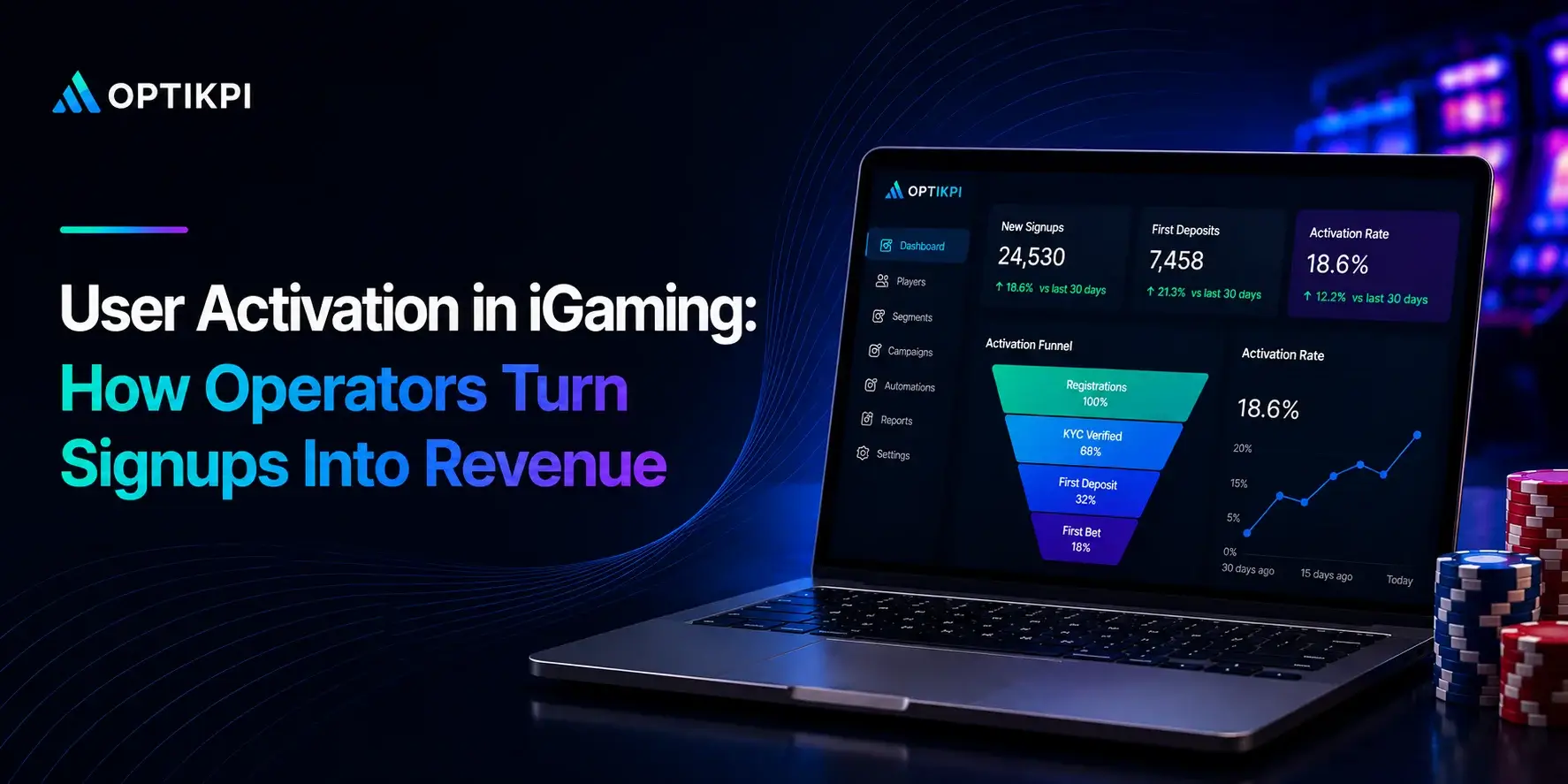
Even after a deposit, a player still needs to actually play. Operators sometimes assume the job is done once money lands in an account, but a deposit without engagement is a fragile win. The first real-money session is what confirms genuine activation. Mapping these four stages individually, rather than treating “activation” as one single event, is what lets operators diagnose exactly where they are losing players and why.
What Is a Good User Activation Rate in iGaming?
Benchmark ranges vary considerably depending on the market, the product type, and local KYC requirements. A sportsbook in a lightly regulated market will see different numbers to a casino operating under strict European verification rules. That said, a few general patterns hold across most operators.
Registration Completion Benchmarks
Shorter, well-designed registration flows typically retain significantly more players through to a completed signup than long, multi-step forms.
Verification Benchmarks
Markets with streamlined, automated KYC tend to see much stronger verification completion than those relying on manual document review, where delays cause players to disengage.
FTD Benchmarks
The share of verified players who go on to make a first deposit is usually the clearest indicator of how well an operator’s onboarding and payment experience is working.
Time-to-Activation Benchmarks
How quickly a player moves from registration to first deposit matters almost as much as whether they do. Players who take too long to activate are more likely to lose interest altogether, even if they eventually complete the steps.
Note: treat these as directional patterns rather than fixed targets. The right benchmark for your operation depends on your specific product, geography, and regulatory environment.
Quick Wins vs Structural Fixes for Activation
Quick Wins
- Reduce the number of fields required at registration.
- Improve the clarity and timing of welcome communications.
- Add deposit reminders for players who verify but don’t fund their account.
- Personalise onboarding messages based on registration source or product interest.
Structural Fixes
- Build behavioural automation that responds to what a player actually does, not a fixed schedule.
- Integrate CRM data across registration, verification, and deposit systems so nothing is siloed.
- Introduce activation scoring to flag players at risk of stalling before they drop off.
- Design omnichannel journeys that reach players across email, SMS, and push, rather than relying on a single channel.
Quick wins improve conversion at the margins. Structural fixes change the shape of the funnel itself. Most operators need both, but the structural work is what produces lasting gains.
See Activation Analytics in Action →
Activation Strategies Used by Leading Operators
Lifecycle Messaging
Leading operators map communication to where a player actually sits in the funnel, rather than sending the same sequence to everyone. A player who has verified but not deposited needs a different message to one who has just registered.
Trigger-Based Campaigns
Instead of fixed-schedule emails, top-performing operators trigger messages based on real player actions: an abandoned deposit form, a completed verification, an inactive account after a promising first session.
Progressive Onboarding
Rather than front-loading every instruction at once, strong onboarding introduces guidance in stages, matched to what a player needs to do next. This keeps the process manageable and reduces the sense of friction.
Behavioural Segmentation
Grouping players by behaviour rather than static demographics allows operators to tailor activation journeys more precisely. A player who browses sports markets behaves differently to one exploring slots, and the activation path should reflect that.
Measuring User Activation Performance
Activation Rate
The percentage of registered players who complete the full journey to a first real-money session. This is the headline number, but it should always be broken down by funnel stage to be useful.
Verification Rate
The share of registered players who successfully complete KYC. A low verification rate points to friction in the identity check process itself.
FTD Rate
The share of verified players who go on to make a first deposit. This is often the single most revealing number in the entire funnel.
Time to Activation
How long it takes a player to move from registration to first deposit. Shorter is generally better, since delay tends to correlate with lost intent.
Early Retention Rate
Whether a newly activated player returns for a second session. Activation that doesn’t lead to any follow-up engagement is a weak signal, even if it technically counts as a conversion.
Tracked together, these metrics connect activation directly to revenue outcomes, rather than treating it as an abstract engagement score.
How OptiKPI Helps Operators Improve User Activation
Improving activation isn’t about a single fix. It’s about having visibility into exactly where players are dropping off, and the tools to act on that visibility quickly. This is where OptiKPI’s iGaming CRM platform built specifically for operators makes the difference between guessing and knowing.
Activation Dashboards
OptiKPI gives operators a live view of activation performance across registration, verification, and first deposit, without needing to piece together data from separate systems. Instead of finding out about a drop-off weeks later in a report, teams can see it as it happens.
Funnel Analytics
Rather than treating activation as one number, OptiKPI breaks it down stage by stage, so operators can see exactly where players are stalling, whether that’s during player onboarding strategies or at the payment step.
Behavioural Insights
OptiKPI tracks how players actually move through the funnel, surfacing patterns such as which registration sources produce the strongest activation rates and which onboarding paths tend to stall. This turns activation from a lagging indicator into something operators can act on in real time.
Revenue Attribution
Activation only matters because of what it leads to. OptiKPI connects activation data back to downstream revenue, so operators can see which improvements to onboarding or verification actually move the needle on player value, not just on signup counts.
CRM Intelligence
By combining activation data with broader CRM intelligence, OptiKPI enables operators to trigger the right message at the right stage automatically, closing the gap between a player’s action and the operator’s response. This supports the kind of first-time deposit optimization that turns a promising registration into a funded, active account.
For operators, the value isn’t just seeing the data. It’s being able to act on activation drop-off before it becomes lost revenue.
Book Your Activation Strategy Demo →
FAQs
User activation is the process that takes a new registrant through identity verification, first-time deposit, and first real-money session. It marks the point where a signup becomes an actual player.
Because registration alone doesn’t generate revenue. An unactivated player represents acquisition spend with no return. Activation is what determines whether marketing investment actually converts into paying customers.
Benchmarks vary by market, product type, and KYC requirements, so there is no single universal figure. Operators should focus on tracking their own activation rate by funnel stage and improving it over time, rather than chasing an industry-wide number.
Through a combination of quick wins, such as shorter registration forms and better-timed communications, and structural fixes, such as behavioural automation, CRM integration, and activation scoring that flags at-risk players before they drop off.
Activation rate, verification rate, FTD rate, time to activation, and early retention rate. Tracked together, these give a complete picture of where players succeed and where they stall.