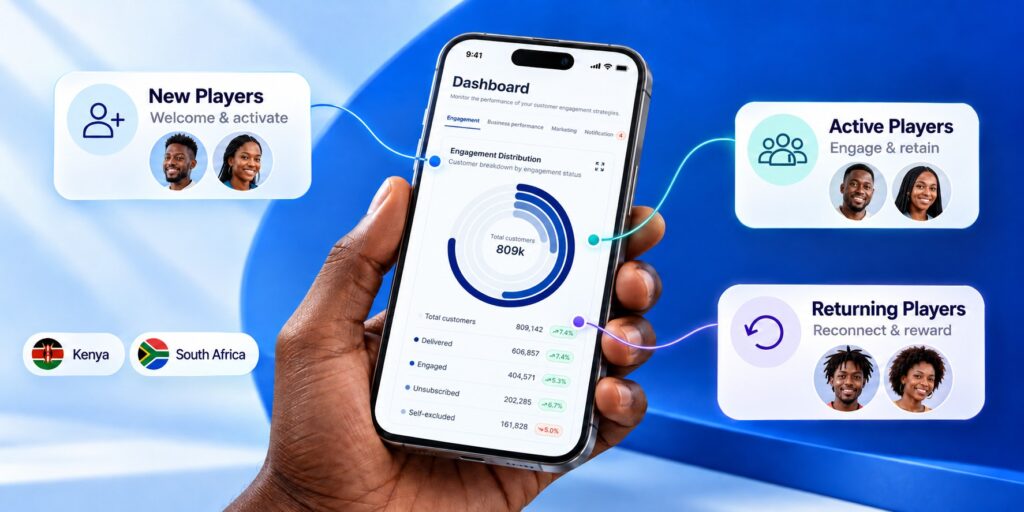
Your CRM team already has segments that keep campaigns moving: new registrations, active casino players, customers approaching a VIP threshold and players who have stopped returning. Those audiences are familiar, although keeping their filters useful can take more attention than anyone expected.
Now AI player segmentation is part of the conversation, bringing questions about churn predictions, better personalisation and whether the existing approach needs replacing.
For an operator comparing rule-based vs AI segmentation, the useful starting point is the decision your team needs to make. Some decisions require explicit eligibility criteria, while others could benefit from understanding patterns that a handful of filters might miss.
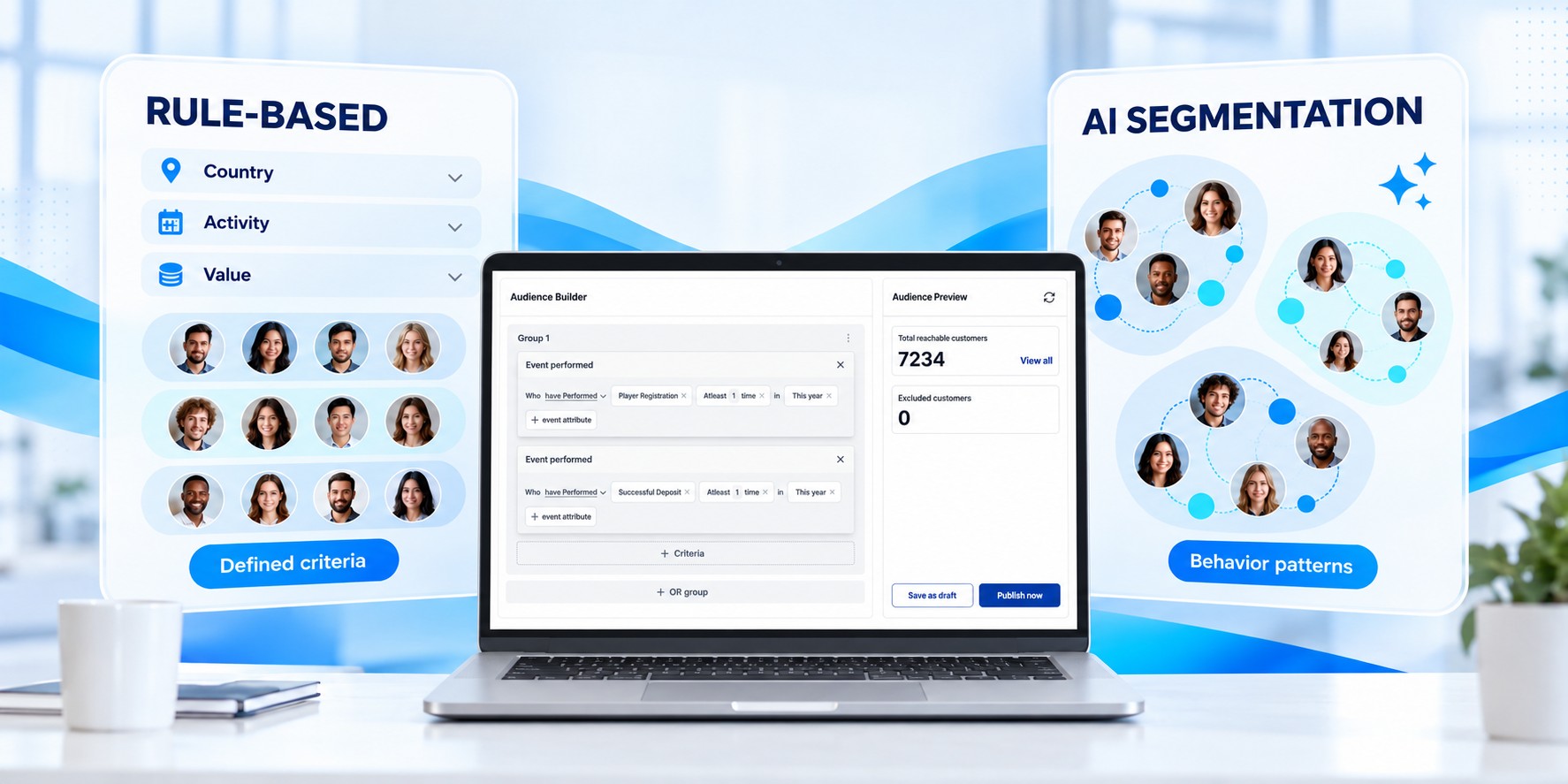
Rule-based segmentation groups players using criteria your team defines; AI segmentation uses machine learning to discover groups or estimate outcomes that inform audience selection. A hybrid approach combines those signals with rules controlling eligibility and execution.
This guide explains how each approach works, where the trade-offs matter and how to choose a practical mix for your data, team and retention goals, without rebuilding every journey that already serves a purpose.
For broader planning, our guide to player segmentation in iGaming connects audience design with the CRM workflows that put it into practice.
What Is Rule-Based Segmentation?
Rule-based segmentation creates player groups through conditions such as registration date, preferred product, account status or recent activity. The team defines the logic, and the CRM includes players who meet it.
A casino audience might require a completed first deposit, slots activity within the previous 30 days and permission to receive the selected marketing channel. Conditions connected through AND, OR and exclusion logic determine membership.
Want to see how this can be managed through CRM?
Explore how OptiKPI helps operators identify early churn signals, segment players and trigger timely retention actions.
Where rule-based segmentation works well
For rule-based segmentation in iGaming, the strongest use cases involve clear business decisions: onboarding stages, published loyalty criteria, jurisdiction restrictions and promotional exclusions. A CRM manager can explain why a player entered an audience and which condition would remove them.
That clarity helps smaller teams build manageable journeys and gives established teams a dependable way to apply campaign policies.
Where it falls short
The challenge appears when player behaviour becomes more varied than the rules account for. Seven days without activity could be unusual for one casino customer and normal for someone who bets around specific fixtures.
Adding filters can make that distinction more precise, but maintaining overlapping audiences eventually becomes demanding. Rules can also update automatically as events arrive, so their limitation is the logic people define, rather than an inherent inability to run in real time.
What Is AI Segmentation?
AI segmentation uses machine learning to identify relationships across player data, producing groups or scores that help determine an audience. Relevant signals might include activity patterns, product preferences, transaction history and previous campaign responses.
Common AI segmentation methods
Clustering groups players with similar characteristics without requiring the team to define every group beforehand. It can reveal overlooked patterns, although grouping similar players does not itself predict whether they will churn. developers.google.com
Predictive scoring estimates a defined outcome, such as inactivity within a specified period, deposit propensity or future player value. Predictive player segmentation uses these estimates to inform audience selection.
Next-best-offer models rank possible treatments using expected responses or value. Predicting an offer response does not prove that the offer caused additional activity, which requires testing. These are general methods, and a platform may support some rather than all of them.
Where AI segmentation works well
AI segmentation for casinos becomes useful when behavioural differences are difficult to capture through a manageable set of filters. A model could help identify changing engagement patterns across a varied player base or support more relevant recommendations for eligible customers.
Where it falls short
Models depend on reliable inputs, suitable historical examples and ongoing evaluation. Duplicate player profiles and missing events can make a prediction unreliable, and your team still needs to understand what the score estimates.
Ask whether the output represents a probability for a defined period, a relative ranking or a category. A label such as “high churn risk” needs a shared interpretation before different teams use it to make campaign decisions.
Fresh data, refreshed scores and model retraining are separate processes, so ask how frequently each happens before planning a time-sensitive campaign.
Rule-Based vs. AI Segmentation: A Side-by-Side Comparison
| Dimension | Rule-based segmentation | AI segmentation |
|---|---|---|
| How segments are created | People define filters, thresholds and exclusions. | Models discover groups or generate scores used in audience selection. |
| Number of variables handled | Can combine many fields, although complex logic becomes harder to maintain. | Can evaluate multiple signals and relationships when suitable data is available. |
| Reactive vs. predictive | Applies explicit logic to known data; can incorporate predictive scores | Clustering describes patterns; predictive models estimate future outcomes. |
| Adapting to behaviour change | Membership can update automatically when conditions change. | Updates depend on data availability and scoring or refresh schedules. |
| Transparency and explainability | Conditions are visible and usually straightforward to explain. | Explanations depend on the model and the tools provided. |
| Team effort to maintain | Requires reviewing thresholds, overlap and journey logic. | Requires data monitoring, model evaluation and campaign oversight. |
| Data requirements | Needs accurate inputs for the chosen conditions. | Needs suitable data for the method; predictive models also need historical outcomes. |
For iGaming CRM segmentation, choose based on the decision involved and the evidence available, then assess whether your team can act on the resulting audience.
Evaluating your current setup? Book an OptiKPI demo and bring one retention segment you would like to improve.
Use Cases: When Each Approach Makes Sense
Best handled with rules
Consider a welcome journey for newly registered players. Account checks, marketing permissions, market availability and completion of the next onboarding step provide explicit conditions for deciding who qualifies.
The same principle applies to bonus eligibility, simple VIP tier thresholds and jurisdiction-based campaign rules. Self-excluded players and customers subject to responsible gambling restrictions require effective suppression, even if a commercial model rates them highly.
Best handled with AI
Imagine two customers with the same number of inactive days. One has gradually reduced a previously regular casino routine, while the other usually returns around particular sporting events. A model with relevant behavioural history could distinguish their patterns more effectively than a single inactivity threshold.
AI can also support future-value estimates, game or sport recommendations, offer selection and discovery of overlooked audiences. Each application needs validation against its own objective, because a player predicted to leave is not necessarily someone a campaign can persuade to return.
A drop in activity could also follow a failed payment or an unresolved support issue. The useful next action may be help with that experience, so a retention journey should not assume every prediction calls for a bonus.
Grey areas
VIP management, reactivation and cross-sell often benefit from combining approaches. A predictive score can inform prioritisation, while rules establish eligibility and a person reviews cases requiring judgement.
For cross-sell, a player whose history suggests interest in another product should enter the audience only when their preferences, market and account status permit that communication.
The Hybrid Approach: Why Most Operators Need Both
A hybrid segmentation approach combines model-based insight with explicit controls over campaign decisions. Rules remain useful wherever eligibility is clear, while AI can help with uncertain decisions that benefit from prediction or pattern discovery.
Consider an illustrative churn-prevention journey. A model identifies players whose behaviour suggests a higher likelihood of becoming inactive. Rules then check marketing permissions, account restrictions, responsible gambling exclusions, contact frequency and any applicable bonus caps before eligible players enter the journey.
Subsequent events can change the treatment or remove someone from the audience, with eligibility checked again before a message is sent. The team should be able to inspect which score informed selection, which rules applied and which action followed.
Churn risk and gambling-harm risk must remain separate concepts; a commercial retention signal must never override player protection.
Want to explore that workflow with your own campaign requirements? Book an OptiKPI demo to discuss hybrid segmentation.
How to Choose the Right Approach for Your Operator
Assess your data maturity
Can your team connect registrations, transactions, gameplay, preferences and account restrictions to a consistent player identity? Check missing events, duplicate profiles and update delays before adding predictions. Data timeliness should match the decision: an immediate trigger and a scheduled planning audience have different needs.
Consider your player base size
There is no universal player count that makes AI worthwhile. The relevant question is whether you have enough representative history and observed outcomes to train and validate the chosen model. Ask how performance will be assessed for your products and markets, including less active cohorts.
Evaluate your team
Someone needs to own audience logic, campaign execution and performance review. A smaller team may gain more from a few explainable predictive signals than from dozens of audiences it cannot serve differently. Ask whether CRM users can understand the scores without waiting for a custom analysis.
Define your retention goals
Choose one initial objective, such as earlier churn detection, more efficient reactivation or lower incentive cost. Define the outcome and observation period before selecting the method. Where your existing process still relies on manual audience work, measure the hours saved alongside campaign impact.
Factor in regulation and responsible gambling
Translate applicable requirements into explicit controls, with ownership for keeping them current. For example, Great Britain’s Gambling Commission requires relevant remote licensees to stop marketing and prevent new bonus uptake when they identify strong indicators of harm. A commercial score cannot override that obligation. Remote customer interaction
A practical maturity path starts with reliable rules, adds validated predictive scores, then connects both through automated journeys where the data and controls support timely decisions.
Common Mistakes When Moving from Rules to AI
Expecting AI to repair fragmented data creates confidence in outputs whose inputs remain unreliable. Resolve identity, event definitions and data completeness before expanding use cases.
Removing established rules too early can weaken eligibility controls and make campaign decisions harder to review. Keep useful conditions while testing where predictions add value.
Accepting unexplained scores leaves CRM teams guessing. Define what each score estimates, the time period it covers and when it was updated.
Comparing differently selected audiences can create misleading results, because an AI audience and a rules audience may have different starting characteristics. Test the selection approaches within a common eligible population.
Creating more segments than your campaigns can use adds maintenance without necessarily improving the player experience. A new audience should lead to a meaningful change in timing, content, eligibility or treatment.
Measuring Which Approach Performs Better
Start with a shared eligible population and randomly assign players to a rule-based approach, an AI-based approach and, where appropriate, a holdout receiving no test campaign. Keep required service and safeguarding communications consistent across groups. Microsoft Research
Define churn and retention before the test, using an observation period appropriate to the product. To isolate segmentation, keep channels, offers, timing and budget constraints comparable; changing them simultaneously evaluates a broader strategy.
Compare outcomes across all assigned players, including those each approach leaves untargeted. Otherwise, different audience selection can distort the comparison.
Decide the sample size and review date before launch, and report uncertainty around the results, so an early fluctuation does not become the reason to roll out a campaign.
Review churn rate, retention, campaign conversion, bonus cost per retained player and CRM team time, alongside contribution after campaign costs. The holdout helps estimate activity that would have occurred without the campaign, while the two treatment groups compare selection approaches.
Track observed value over the measurement period and revisit longer-term outcomes before claiming lifetime value growth. Monitor model performance and drift as player behaviour changes, keeping prediction quality separate from evidence that a campaign creates incremental value.
How OptiKPI Supports Both Rule-Based and AI Segmentation
OptiKPI brings audience building, predictive player signals and campaign execution into an iGaming CRM, giving operators a practical way to explore a hybrid segmentation strategy. OptiKPI
Its audience tools support segmentation using behaviour, demographics and transactions, with a rule builder, audience-size previews and live, scheduled or static refresh modes. Your team can define clear selection criteria and choose how frequently audience membership updates. OptiKPI
AI Copilot adds daily scoring for churn risk, deposit propensity, engagement probability and LTV tier. These signals can inform audience decisions alongside the context available in Customer 360. Daily predictive scoring and live audience updates serve different purposes, so consider both when planning campaign timing. OptiKPI
OptiKPI also supports automated journeys with conditional branches, delays and A/B testing. Event-based or audience-based enrolment connects segmentation with configured workflows, helping teams move from selecting players to executing a campaign. Optimize Customer Journeys with OptiKPI
Bring one existing retention journey to the evaluation, together with its data requirements, exclusions and success metric. Ask to see how audience selection works, how eligibility is checked before contact and how results can be compared with your current approach. That creates a useful starting point for assessing fit across your marketing, CRM and data teams.
Book an OptiKPI demo to explore your segmentation workflow.
Lessons From South Africa: Product Affinity Becomes More Important
South Africa illustrates another important principle.
As product choice broadens, segmentation increasingly needs to understand relationships between verticals.
Operators offering sportsbook and casino products should not treat the entire customer database as one audience.
Some players may remain sportsbook-exclusive for long periods. Others may move naturally between sports and casino products, while another group may begin experimenting with a second vertical only after several months.
These behaviours create opportunities for more precise lifecycle and cross-sell segmentation.
For example, a customer who has demonstrated an emerging interest in casino content could receive a carefully timed relevant recommendation, while a sportsbook-exclusive customer with no casino engagement may be better served with campaigns connected to the sports they already follow.
Cross-selling becomes more effective when it reflects demonstrated interest rather than being pushed indiscriminately across the database.
Turning Player Segments Into Retention Campaigns
Segmentation creates commercial value only when operators can connect segments with actions.
A useful CRM framework is therefore:
Segment + Trigger + Action + Measurement
Consider a newly acquired player who has made a first deposit but has not returned within the timeframe in which similar players normally make their second deposit.
The segment is the first-time depositor.
The trigger is the missing second interaction.
The action might involve a relevant reminder connected to the customer’s previously demonstrated product interest.
The measurement becomes second-deposit rate.
Another example involves a historically active customer whose weekly betting frequency has declined.
The segment is a previously high-engagement player.
The trigger is declining activity.
The action could involve a personalised re-engagement journey rather than a generic mass promotion.
The measurement becomes reactivation and subsequent retention.
Operators can apply the same thinking across many situations.
A jackpot-focused player could receive relevant communication around upcoming jackpot opportunities, while a sportsbook customer with emerging casino engagement could receive a contextual introduction to casino content.
What matters is that campaigns begin with recognised player behaviour rather than the campaign calendar.
Why Real-Time Segmentation Matters
Timing is one of the most important differences between traditional CRM and modern behavioural CRM.
A player can change quickly.
Someone who was highly active last week may already be showing signs of declining engagement today.
Someone who previously behaved like a casual sportsbook customer may suddenly begin exploring another gaming product.
Someone who completed their first deposit yesterday may already be entering the period where the probability of returning starts falling.
If segmentation is refreshed only periodically, CRM teams may discover these changes after the commercial opportunity has already passed.
Real-time segmentation allows audiences to change as player behaviour changes.
This is especially useful in environments where sessions are short, betting decisions happen quickly and sporting events create narrow engagement windows.
Instead of repeatedly exporting customer lists and manually rebuilding audiences, CRM teams can work with continuously updated behavioural segments.
Where AI Can Improve Player Segmentation
AI becomes useful when operators move beyond describing what a player has already done and begin estimating what is likely to happen next.
Traditional segmentation might identify players who became inactive thirty days ago.
Predictive segmentation can attempt to identify players whose changing behaviour suggests they are becoming more likely to churn before inactivity occurs.
The difference is strategically important.
Retention is usually easier when the player relationship still exists.
AI models can potentially examine combinations of behavioural signals such as falling deposit frequency, longer gaps between sessions, reduced betting activity or changing product engagement.
CRM teams can then prioritise customers according to predicted behaviour rather than waiting for fixed rules to be triggered.
Next-best-action approaches can also help operators decide what type of journey may be most relevant for different audiences.
The objective is not to remove the CRM team from the process.
The objective is to give the team better information about where attention is required.
Responsible Gambling Must Remain Part of Segmentation
More precise segmentation creates greater marketing power, which means responsible use becomes even more important.
High-frequency activity should never automatically be interpreted as an opportunity for increasingly aggressive promotion.
Operators should ensure that player segmentation also supports responsible gambling processes by helping identify behavioural patterns that may require reduced promotional activity, intervention or suppression from certain journeys.
The same behavioural intelligence that allows an operator to identify engagement can therefore also help the business recognise situations where marketing pressure should decrease.
Responsible segmentation ultimately means understanding when communication is appropriate and when it is not.
Measuring Whether Your Segmentation Strategy Is Actually Working
Creating sophisticated segments is not the objective.
Improving meaningful business outcomes is.
Operators should therefore evaluate segmentation according to retention and customer value metrics rather than the number of audiences created inside the CRM platform.
Useful measurements can include:
- Second-deposit rate
- Deposit frequency
- Player retention rate
- Dormancy rate
- Reactivation rate
- Lifetime value by segment
- Conversion rate by campaign and segment
- Engagement by channel
- Bonus cost per retained player
- Movement between lifecycle stages
Control groups are also important because they help CRM teams understand whether an intervention actually created incremental improvement.
If 18 percent of a targeted segment returns after receiving a campaign but 17 percent of an equivalent control group returns without receiving anything, the campaign may not be delivering the value the headline conversion rate suggests.
Segmentation should therefore support testing, not replace it.
How OptiKPI Helps Operators Move From Player Data to Player Action
OptiKPI brings audience building, predictive player signals and campaign execution into an iGaming CRM, giving operators a practical way to explore a hybrid segmentation strategy. OptiKPI
Its audience tools support segmentation using behaviour, demographics and transactions, with a rule builder, audience-size previews and live, scheduled or static refresh modes. Your team can define clear selection criteria and choose how frequently audience membership updates. OptiKPI
AI Copilot adds daily scoring for churn risk, deposit propensity, engagement probability and LTV tier. These signals can inform audience decisions alongside the context available in Customer 360. Daily predictive scoring and live audience updates serve different purposes, so consider both when planning campaign timing. OptiKPI
OptiKPI also supports automated journeys with conditional branches, delays and A/B testing. Event-based or audience-based enrolment connects segmentation with configured workflows, helping teams move from selecting players to executing a campaign. Optimize Customer Journeys with OptiKPI
Bring one existing retention journey to the evaluation, together with its data requirements, exclusions and success metric. Ask to see how audience selection works, how eligibility is checked before contact and how results can be compared with your current approach. That creates a useful starting point for assessing fit across your marketing, CRM and data teams.
Book an OptiKPI demo to explore your segmentation workflow.
Choosing a Segmentation Approach Your Team Can Use
Your segmentation strategy should make retention decisions easier to explain, execute and evaluate. Rules provide clear control over who qualifies for a journey, while AI can reveal patterns and estimate outcomes that inform more nuanced audience choices.
The right mix depends on your data maturity, the decisions you need to improve and your team’s ability to act on the results. Start with one use case, preserve essential controls and expand when testing gives you a reason to do so.
Book an OptiKPI demo and bring the retention challenge you want to solve first, whether that is identifying changing engagement, refining an existing audience or connecting segmentation with campaign execution.
FAQs
AI segmentation can help when useful patterns are difficult to express through manageable rules and sufficient data is available. Rules remain effective for explicit eligibility and lifecycle logic, so performance should be tested against a defined business objective.
Can rule-based and AI segmentation be used together?
Yes, a hybrid approach uses AI signals to inform audience selection and rules to determine eligibility, exclusions and campaign constraints. For example, a churn score can help prioritise players while marketing permissions and responsible gambling controls govern contact.
How much data does AI segmentation need?
Data requirements depend on the method, outcome, available history and diversity of player behaviour. Predictive models need enough reliable examples to learn and validate the target outcome, so assess suitability through your own data rather than a universal player-count threshold.
It can be suitable when an operator has usable data, a clear objective and capacity to act on the outputs. Starting with one predictive use case alongside existing rules provides a manageable way to evaluate whether the additional complexity is worthwhile.