
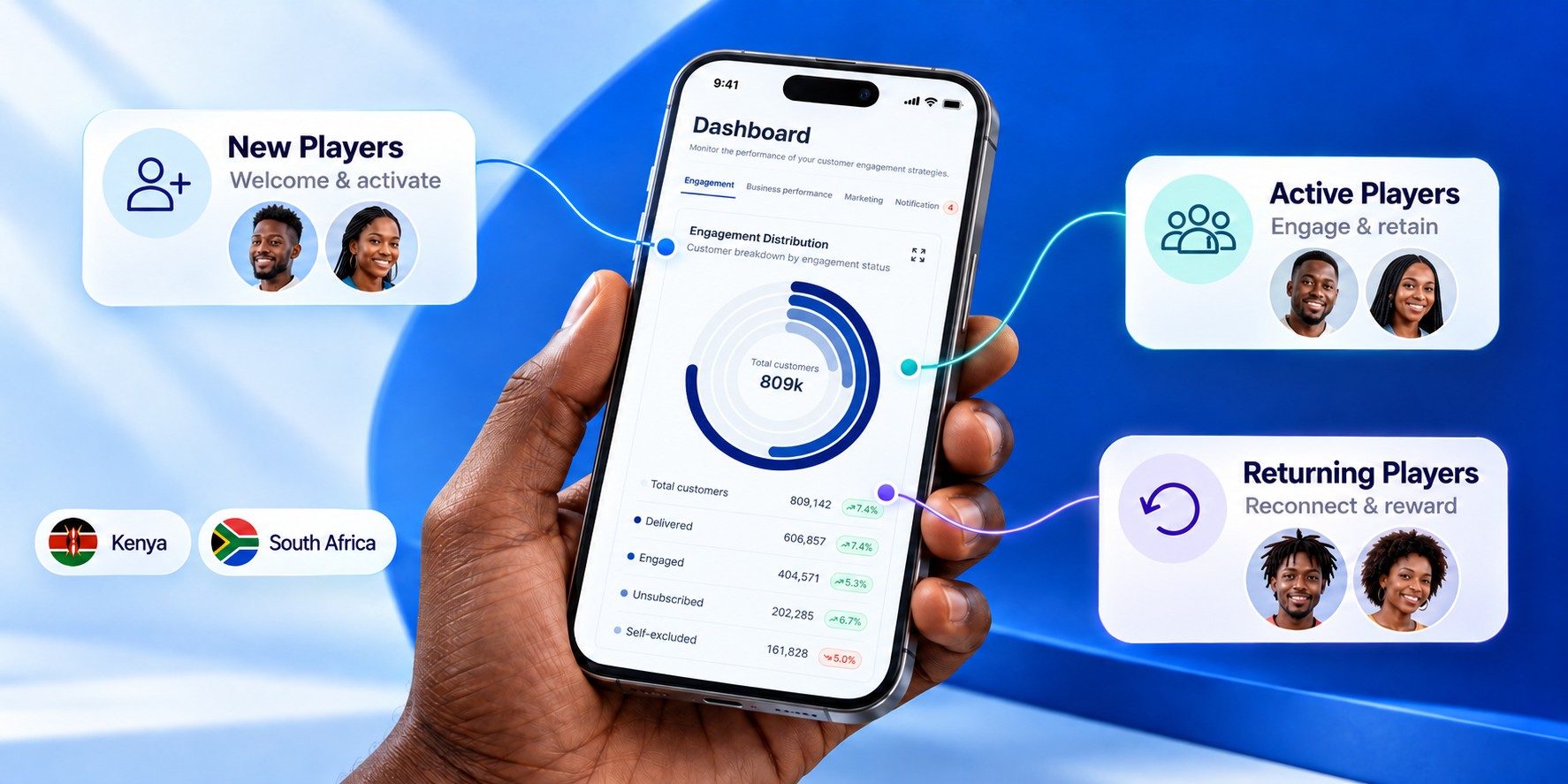
For many betting operators across Africa, mobile is not simply another customer touchpoint alongside desktop, retail and email. Mobile is where the relationship with the player begins, where deposits happen, where bets are placed, where promotions are viewed and where operators have the narrowest window to influence what happens next.
That distinction changes how player segmentation needs to work.
Segmentation models originally designed around desktop-heavy markets can miss important behavioural signals when applied to mobile-first betting audiences. A player making several small deposits and placing frequent low-value bets, for example, may appear less valuable than someone making an occasional larger deposit when traditional value thresholds are used. In reality, the first player may demonstrate stronger engagement, greater retention potential and considerably more lifetime value over time.
Kenya and South Africa provide useful examples because both are strongly mobile-led betting markets, yet their player behaviours, payment patterns and product preferences can differ considerably.
For sportsbook and casino operators entering these markets, or trying to increase retention within an existing African player base, effective segmentation therefore needs to go beyond basic characteristics such as age, location and total deposits.
It needs to understand what players are actually doing.
This means looking at frequency, payment behaviour, preferred sports, betting patterns, product affinity, device behaviour, lifecycle stage and changing engagement signals in real time.
The operators that can turn those signals into relevant player journeys have a much better opportunity to increase second deposits, reduce early churn and grow player lifetime value without simply increasing promotional spend.
Want to see how real-time player segmentation could work across your sportsbook or casino player base? Book an OptiKPI demo and explore how behavioural data can be turned into actionable player segments and automated journeys.
What Makes an iGaming Market Mobile-First?
A mobile-first betting market is not simply a market where many players happen to own smartphones.
From an operator perspective, it is a market where registrations, deposits, browsing activity, betting sessions and ongoing engagement happen predominantly through mobile devices, often within shorter and more frequent interactions than operators would typically see in desktop-led environments.
This distinction matters because player behaviour looks different when mobile becomes the primary betting environment.
Sessions may be shorter, yet players can return several times throughout the day. Individual stakes may be relatively modest, while the frequency of betting activity can be significant. Engagement may also be strongly influenced by sporting calendars, salary cycles, payment availability and immediate events such as an upcoming football match.
For CRM teams, these patterns create a very different segmentation problem.
A player who places five smaller bets every week should not necessarily be treated in the same way as a player who deposits the same total amount once every several weeks. Their monetary value may initially appear similar, but their habits, retention probability and opportunities for engagement are considerably different.
Mobile-first segmentation therefore needs to place greater emphasis on behaviour and timing rather than relying primarily on static player profiles.
Want to see how this can be managed through CRM?
Explore how OptiKPI helps operators identify early churn signals, segment players and trigger timely retention actions.
Why traditional segmentation models can underperform
Many conventional player segmentation frameworks begin with broad categories such as high-value players, casual players, VIPs, inactive customers and new depositors.
Those classifications remain useful, but they can become too simplistic when used on their own.
Consider two sportsbook players who have each deposited €100 during the last month.
One player deposited €100 once, placed two bets and has not returned for three weeks. The other deposited approximately €10 several times throughout the month, regularly follows football fixtures and continues opening the sportsbook application every weekend.
Looking only at total deposit value could place them in the same segment.
Looking at frequency immediately tells a different story.
This is why operators targeting mobile-first markets need segmentation models that combine value with behavioural intensity, recency, frequency, preferred products, payment patterns and engagement trends.
Kenya and South Africa: Two Mobile-First Markets With Different Player Dynamics
Kenya and South Africa share several characteristics that make them valuable markets for understanding mobile betting behaviour, although operators should avoid assuming that the same CRM playbook will work equally well across both countries.
Player segmentation in Kenya
Kenya is strongly associated with sportsbook activity, particularly football betting, while mobile payment behaviour plays an important role in the overall customer experience.
For CRM teams, the important lesson is that individual transaction size cannot tell the complete story of player value.
Frequent betting activity, repeated deposits, preferred competitions, multibet behaviour, jackpot engagement and the timing of betting sessions can provide considerably more useful information about how a player should be treated.
A Kenyan sportsbook operator might therefore build segments around questions such as:
- Which players deposit repeatedly despite maintaining relatively small average transaction values?
- Which players consistently engage before major football fixtures?
- Which customers prefer jackpots or accumulator-style products?
- Which new depositors fail to return after their first betting session?
- Which previously active players are gradually reducing their weekly betting frequency?
These segments provide a clearer foundation for retention marketing because they reflect actual betting behaviour rather than broad demographic assumptions.
Player segmentation in South Africa
South Africa presents a somewhat different segmentation environment because operators may be dealing with a broader combination of sportsbook and online casino engagement, multiple payment preferences and different patterns of player value.
For CRM teams, this creates additional opportunities to segment according to product affinity.
A sportsbook player who consistently engages with football may behave differently from another sports customer who occasionally explores casino products. A casino-first player who has recently started betting on sporting events should also not receive the same journey as someone who exclusively uses sportsbook products.
Operators can therefore benefit from identifying:
- Sportsbook-only players
- Casino-first players
- Multi-product players
- Players beginning to explore a second vertical
- High-frequency sports bettors
- High-value but declining-frequency players
- Players with particular payment preferences
- Recently dormant players who previously showed strong engagement
The purpose is not to create hundreds of segments simply because the data allows it.
The purpose is to create segments that change what the operator does next.
If your CRM team has player data but still relies heavily on broad VIP, active and inactive segments, OptiKPI can help you explore a more behavioural approach to segmentation. Book a demo to see how granular player audiences and real-time journeys can be managed from a unified player data environment.
The Data Signals That Matter Most in Mobile-First Betting Markets
Good segmentation starts with good signals.
Operators often collect enormous quantities of player data but struggle to decide which information should actually influence CRM activity. In mobile-first markets, several categories deserve particular attention.
Deposit frequency and payment behaviour
Deposit value is important, but deposit behaviour often reveals more.
Operators should consider analysing deposit frequency, average transaction value, failed payment attempts, changes in deposit patterns and the time periods when players usually fund their accounts.
A player who normally deposits every Friday but suddenly stops for several weeks may deserve a different journey from a customer whose deposit behaviour has always been irregular.
Likewise, a customer making repeated unsuccessful deposits may require assistance rather than another promotional offer.
Payment signals therefore become valuable not only for identifying monetary value, but also for understanding friction and possible churn.
Betting frequency
Frequency is particularly useful when player value is distributed across many relatively small interactions.
CRM teams can examine:
- Number of betting days per week
- Number of bets placed
- Time between betting sessions
- Deposit-to-bet frequency
- Changes in weekly activity
- Pre-match versus live betting behaviour
- Preferred bet formats
A player whose activity falls from twenty bets per week to five could represent a significant churn warning even when that player has technically remained active.
Traditional active-versus-inactive segmentation may completely miss this change.
Sport and league affinity
Knowing that a customer is a sportsbook player provides very limited marketing intelligence.
Knowing that the customer follows the English Premier League, usually places bets shortly before kick-off and frequently creates multibets provides considerably more useful context.
Operators can build affinity segments around competitions, sports, bet types and recurring behavioural patterns.
This allows campaigns to become relevant because the communication is connected to demonstrated interests rather than generic assumptions about what every sportsbook player wants.
Product preference
Product preference becomes particularly valuable for operators running several gaming verticals.
Sportsbook players, casino players, jackpot players, crash-game users, live bettors and customers who regularly move across products can all demonstrate different engagement patterns.
Product preference segmentation can therefore support both retention and responsible cross-sell strategies.
A sportsbook customer who begins browsing casino content, for example, represents a very different opportunity from a player who has never demonstrated any interest outside sports betting.
Device and session behaviour
Mobile engagement itself can contain useful segmentation signals.
Operators can look at whether customers use an application or mobile website, how often they return, how long sessions usually last and whether engagement patterns have recently changed.
A sudden decline in session frequency may provide an earlier warning of churn than waiting for the player to become fully dormant.
Lifecycle signals
Lifecycle segmentation becomes far more valuable when it reflects actual player behaviour rather than arbitrary time periods.
Instead of defining every player who has not deposited for thirty days as inactive, operators can examine the customer’s normal behavioural rhythm.
For someone who previously deposited three times every week, seven days without activity may already be significant.
For another player who naturally returns once every month, the same seven-day period tells the operator almost nothing.
This is where personalised lifecycle segmentation becomes considerably more powerful than fixed CRM rules.
Segmentation Models That Work Better in Mobile-First Markets
Once the correct signals are available, operators can start combining them into segments that genuinely influence campaigns.
Frequency-led value segmentation
Traditional value segmentation often focuses heavily on monetary thresholds.
Mobile-first operators should consider combining monetary value with behavioural frequency.
This could produce segments such as:
High frequency, high value: Players who require strong retention and potentially personalised relationship management.
High frequency, moderate value: Consistently engaged players whose cumulative lifetime value may become significant.
Declining frequency, historically high value: Players showing an important early churn signal.
Low frequency, increasing value: Customers whose engagement is moving in a positive direction.
This approach provides considerably more context than simply categorising everyone by total deposit amount.
Sport and competition affinity segments
Operators can create audiences based on the competitions and sports that repeatedly generate player activity.
Rather than sending the same Saturday promotion to the entire sportsbook database, CRM teams can build campaigns around recognised player preferences and relevant upcoming events.
Greater relevance can increase engagement without requiring an operator to constantly increase bonus value.
Product preference segments
Players can also be grouped according to the products they repeatedly use.
Examples could include jackpot-focused players, live bettors, accumulator builders, casino-heavy players, crash-game players and customers regularly using multiple products.
The resulting campaigns become more meaningful because recommendations can be connected to previous behaviour.
Payment-cycle segments
Some players demonstrate predictable activity around recurring financial cycles.
The important principle here is not to aggressively target customers based on perceived affordability.
Instead, payment timing can be treated as one contextual signal among several behavioural indicators while operators maintain appropriate responsible gambling controls and avoid exploitative communication.
Fast-churning new depositor segments
One of the biggest opportunities for segmentation appears immediately after acquisition.
A registered user who never deposits represents a different problem from a player who deposits once, places several bets and then disappears.
The second customer has already crossed an important conversion threshold.
The operator’s next objective becomes encouraging healthy continued engagement rather than allowing the relationship to disappear after a single session.
This makes second-deposit rate an extremely valuable retention metric.
Acquiring players is expensive. Losing them immediately after their first deposit makes acquisition even more expensive. See how OptiKPI can help your CRM team identify lifecycle changes and create automated retention journeys before valuable players disappear.
Lessons From Kenya: Frequency Can Reveal Value That Deposit Size Misses
One of the most important lessons mobile-first sportsbook operators can take from markets such as Kenya is that value does not always arrive through large individual transactions.
It can accumulate through frequency.
A customer making smaller but consistent deposits, returning for major matchdays and repeatedly engaging with preferred competitions may eventually become more commercially valuable than someone who makes a much larger first deposit but rarely returns.
This should influence how operators design both segmentation and retention programmes.
Instead of asking only:
“How much has this player deposited?”
CRM teams should also ask:
“How frequently does this player return, how is that frequency changing and which events normally trigger engagement?”
That shift creates several useful segmentation possibilities.
An operator might identify highly engaged football players whose activity normally increases during weekends, customers whose jackpot participation follows a recurring cycle, or previously frequent bettors whose activity has begun to decline.
Each segment can then receive a different journey based on what the behavioural data suggests is happening.
The result is a CRM strategy built around player context rather than simply promotional broadcasting.
Lessons From South Africa: Product Affinity Becomes More Important
South Africa illustrates another important principle.
As product choice broadens, segmentation increasingly needs to understand relationships between verticals.
Operators offering sportsbook and casino products should not treat the entire customer database as one audience.
Some players may remain sportsbook-exclusive for long periods. Others may move naturally between sports and casino products, while another group may begin experimenting with a second vertical only after several months.
These behaviours create opportunities for more precise lifecycle and cross-sell segmentation.
For example, a customer who has demonstrated an emerging interest in casino content could receive a carefully timed relevant recommendation, while a sportsbook-exclusive customer with no casino engagement may be better served with campaigns connected to the sports they already follow.
Cross-selling becomes more effective when it reflects demonstrated interest rather than being pushed indiscriminately across the database.
Turning Player Segments Into Retention Campaigns
Segmentation creates commercial value only when operators can connect segments with actions.
A useful CRM framework is therefore:
Segment + Trigger + Action + Measurement
Consider a newly acquired player who has made a first deposit but has not returned within the timeframe in which similar players normally make their second deposit.
The segment is the first-time depositor.
The trigger is the missing second interaction.
The action might involve a relevant reminder connected to the customer’s previously demonstrated product interest.
The measurement becomes second-deposit rate.
Another example involves a historically active customer whose weekly betting frequency has declined.
The segment is a previously high-engagement player.
The trigger is declining activity.
The action could involve a personalised re-engagement journey rather than a generic mass promotion.
The measurement becomes reactivation and subsequent retention.
Operators can apply the same thinking across many situations.
A jackpot-focused player could receive relevant communication around upcoming jackpot opportunities, while a sportsbook customer with emerging casino engagement could receive a contextual introduction to casino content.
What matters is that campaigns begin with recognised player behaviour rather than the campaign calendar.
Why Real-Time Segmentation Matters
Timing is one of the most important differences between traditional CRM and modern behavioural CRM.
A player can change quickly.
Someone who was highly active last week may already be showing signs of declining engagement today.
Someone who previously behaved like a casual sportsbook customer may suddenly begin exploring another gaming product.
Someone who completed their first deposit yesterday may already be entering the period where the probability of returning starts falling.
If segmentation is refreshed only periodically, CRM teams may discover these changes after the commercial opportunity has already passed.
Real-time segmentation allows audiences to change as player behaviour changes.
This is especially useful in environments where sessions are short, betting decisions happen quickly and sporting events create narrow engagement windows.
Instead of repeatedly exporting customer lists and manually rebuilding audiences, CRM teams can work with continuously updated behavioural segments.
Where AI Can Improve Player Segmentation
AI becomes useful when operators move beyond describing what a player has already done and begin estimating what is likely to happen next.
Traditional segmentation might identify players who became inactive thirty days ago.
Predictive segmentation can attempt to identify players whose changing behaviour suggests they are becoming more likely to churn before inactivity occurs.
The difference is strategically important.
Retention is usually easier when the player relationship still exists.
AI models can potentially examine combinations of behavioural signals such as falling deposit frequency, longer gaps between sessions, reduced betting activity or changing product engagement.
CRM teams can then prioritise customers according to predicted behaviour rather than waiting for fixed rules to be triggered.
Next-best-action approaches can also help operators decide what type of journey may be most relevant for different audiences.
The objective is not to remove the CRM team from the process.
The objective is to give the team better information about where attention is required.
Responsible Gambling Must Remain Part of Segmentation
More precise segmentation creates greater marketing power, which means responsible use becomes even more important.
High-frequency activity should never automatically be interpreted as an opportunity for increasingly aggressive promotion.
Operators should ensure that player segmentation also supports responsible gambling processes by helping identify behavioural patterns that may require reduced promotional activity, intervention or suppression from certain journeys.
The same behavioural intelligence that allows an operator to identify engagement can therefore also help the business recognise situations where marketing pressure should decrease.
Responsible segmentation ultimately means understanding when communication is appropriate and when it is not.
Measuring Whether Your Segmentation Strategy Is Actually Working
Creating sophisticated segments is not the objective.
Improving meaningful business outcomes is.
Operators should therefore evaluate segmentation according to retention and customer value metrics rather than the number of audiences created inside the CRM platform.
Useful measurements can include:
- Second-deposit rate
- Deposit frequency
- Player retention rate
- Dormancy rate
- Reactivation rate
- Lifetime value by segment
- Conversion rate by campaign and segment
- Engagement by channel
- Bonus cost per retained player
- Movement between lifecycle stages
Control groups are also important because they help CRM teams understand whether an intervention actually created incremental improvement.
If 18 percent of a targeted segment returns after receiving a campaign but 17 percent of an equivalent control group returns without receiving anything, the campaign may not be delivering the value the headline conversion rate suggests.
Segmentation should therefore support testing, not replace it.
How OptiKPI Helps Operators Move From Player Data to Player Action
Many operators already possess the data required to improve segmentation.
The bigger challenge is making that information usable.
Player data can exist across transactional systems, gaming platforms, marketing tools and reporting environments, leaving CRM teams with fragmented customer views and slow manual processes.
OptiKPI is designed to help operators turn that fragmented behavioural data into usable player intelligence through a unified customer data environment, real-time segmentation, AI-driven predictions and automated player journeys.
Instead of relying only on static audiences such as active, inactive or VIP, CRM teams can build more granular segments around player behaviour, lifecycle stage, value, product preference and changing engagement patterns.
Real-time segmentation allows audiences to update as behaviour changes, while AI capabilities can help teams identify patterns such as potential churn and emerging player opportunities earlier.
For operators managing large player databases, the operational benefit can be just as important as the analytical benefit because CRM teams can run more targeted journeys without manually rebuilding player lists every time behaviour changes.
The result is a CRM model where operators can move from:
“Which campaign should we send today?”
to:
“Which players need an action today, and what should that action be?”
That is a fundamentally different approach to retention.
Your sportsbook already has player data. The opportunity is turning it into revenue-generating retention intelligence. Book an OptiKPI demo and see how real-time segmentation, unified player data, AI predictions and automated CRM journeys can fit into your existing retention strategy.
Mobile-First Markets Need Mobile-First Player Intelligence
Kenya and South Africa demonstrate why effective player segmentation cannot simply be copied from one market and applied unchanged to another.
Both markets highlight the importance of mobile behaviour, but differences in product preference, payment behaviour, player frequency and market structure mean that operators need segmentation strategies built around local customer behaviour.
The central lesson is straightforward.
Player value is not contained in one metric.
It exists across frequency, recency, deposits, betting behaviour, product preference, lifecycle progression and changing engagement patterns.
Operators that can connect these signals can build more relevant player journeys, identify churn earlier and make retention marketing more efficient.
Those that continue relying on broad static groups risk recognising important player changes only after the opportunity to act has already disappeared.
Ready to move beyond basic player segments? Book an OptiKPI demo and discover how your player data can become real-time audiences, predictive insights and automated retention journeys designed around the way your customers actually behave.
FAQs
A mobile-first iGaming market is one where players predominantly register, deposit, place bets and interact with an operator through mobile devices rather than treating mobile as a secondary channel. This behaviour often creates shorter but more frequent sessions, making frequency, timing, product affinity and changing engagement patterns particularly important segmentation signals.
Kenyan betting operators can consider segmenting players according to betting frequency, deposit frequency, sport and league affinity, preferred bet types, product usage, lifecycle stage and changes in engagement over time. The most useful segmentation model will depend on the operator’s own player data and product mix rather than relying on a universal market template.
Yes, payment behaviour can provide useful segmentation signals when operators analyse factors such as deposit frequency, average transaction patterns, changing deposit behaviour and failed payment activity. These signals should be used responsibly and alongside broader behavioural information rather than being treated as standalone indicators of player value.
The appropriate channel depends on the operator’s audience, permissions, market requirements and individual player preferences. CRM strategies should therefore measure actual engagement by channel and allow those results to influence how individual segments are contacted.
How can operators reduce player churn in mobile-first markets?
Operators can reduce churn by identifying behavioural changes earlier, particularly reductions in betting frequency, deposit frequency, session activity and product engagement. Real-time and predictive segmentation can help CRM teams identify potentially declining players before they become fully dormant, allowing relevant retention journeys to begin earlier.
Traditional segmentation usually places players into audiences based on periodically updated rules or historical characteristics, while real-time segmentation updates audiences as new player activity occurs. Real-time segmentation can therefore help operators react more quickly when engagement, product usage or lifecycle behaviour changes.