Player acquisition may bring people through the door, but long-term operator performance depends heavily on what happens after the first deposit.
That makes iGaming player retention one of the most important and difficult responsibilities for CRM and marketing teams. The challenge is rarely a shortage of campaign ideas. Most teams already know they should identify declining activity, reactivate valuable players, personalise offers, and communicate at the right moment.
The real problem is the time between noticing a behaviour change and actually doing something about it.
Traditional workflows can involve dashboards, analyst requests, exports, manual segmentation, campaign setup, approvals, and reporting before a CRM manager can act.
This is where AI in iGaming is beginning to change the workflow.
A CRM copilot adds a conversational AI layer inside an iGaming CRM, allowing teams to ask questions about player behaviour in natural language, create segments, explore trends, and prepare campaigns without moving through several disconnected tools.
The important change is not simply that AI can generate text.
It is that the distance between a question and an action becomes much shorter.
This article walks through what that looks like in practice.
1. Why Player Retention Is the Hardest Job in iGaming
Retention is difficult because players have very little friction preventing them from moving between operators.
A casino player can hold accounts with several brands. A sportsbook player can compare promotions, markets, odds, and experiences across multiple platforms. If engagement drops, there is rarely a long switching process standing in the way.
That places enormous pressure on CRM teams.
The obvious reaction is often to increase bonuses and promotional activity. However, bonus-led retention becomes expensive when the same incentives are sent to broad groups regardless of player behaviour, value, preference, or likelihood to respond.
A player who regularly plays slots may react differently from someone who primarily visits for live casino. A high-value sportsbook player who has stopped depositing may require a different strategy from someone who registered recently but has only placed one small bet.
Treating every inactive player the same can waste budget while producing weak results.
The second problem is data fragmentation.
A typical CRM team may need information from the player account system, payments, games, sportsbook activity, campaigns, bonuses, and behavioural events before deciding what to do next.
The data may exist, but accessing it quickly enough to influence a campaign is often the difficult part.
This is why effective player retention depends on more than having data.
Teams need to be able to ask the right question, understand the answer, create the relevant audience, and respond while the opportunity is still meaningful.
Want to see how this can be managed through CRM?
Explore how OptiKPI helps operators identify early churn signals, segment players and trigger timely retention actions.
2. The Traditional iGaming CRM Workflow and Where It Slows Down
Consider a simple retention question:
Which valuable players who deposited regularly last month have significantly reduced their activity this month?
The question itself is straightforward.
The traditional workflow that follows often is not.
1. The CRM team identifies the
A retention manager notices that deposits or activity appear to be falling within a valuable player group.
The team now needs to determine exactly which players are affected.
2. Data has to be located
If the required information is not already available inside an existing dashboard, the CRM manager may need support from a BI or analytics team.
That can mean explaining the requirement, defining the player criteria, waiting for a query, and checking whether the returned data answers the original question.
3. The audience is built
Once the data is available, the team translates the analysis into a usable segment.
Filters might include deposit behaviour, last activity date, game preference, player value, geography, or previous campaign engagement.
Each additional condition can create another opportunity for errors or delays.
4. The campaign is configured
The CRM manager then chooses the communication channel, prepares the message, selects an incentive if one is appropriate, determines timing, and creates the campaign or automated journey.
5. Results are analysed
After the campaign runs, the team needs to measure what happened.
That may involve another dashboard, an export, spreadsheet work, or another request to the analytics team.
The underlying problem is therefore not necessarily the capability of the iGaming CRM.
It is the number of steps between the initial question and the final decision.
SQL dependency, manual reporting, static segments, spreadsheet exports, and disconnected workflows all increase the time required to act.
When player behaviour changes quickly, that delay matters.
3. What Is a CRM Copilot?
A CRM copilot is a conversational AI layer that operates inside a CRM and helps users interact with player data using ordinary language.
Instead of manually navigating multiple dashboards or constructing complex filters, a CRM manager might ask:
“Which VIP players have not deposited in the last 14 days?”
The copilot can interpret the request, use the data available inside the CRM, and return the relevant players, trends, or segment.
The important distinction is that a CRM copilot should not be treated as a generic chatbot added to a dashboard.
A useful copilot understands the CRM environment it operates within.
It should be able to help the team move from a question to something operational, such as an audience, campaign idea, report, or next action.
It is also not designed to replace the CRM team.
The CRM manager still determines the strategy, decides whether the segment makes sense, reviews the offer, checks the communication, and approves what ultimately reaches the player.
The copilot reduces repetitive work around finding and organising information so that the team can spend more time making decisions.
How a Copilot Changes the Retention Workflow Step by Step
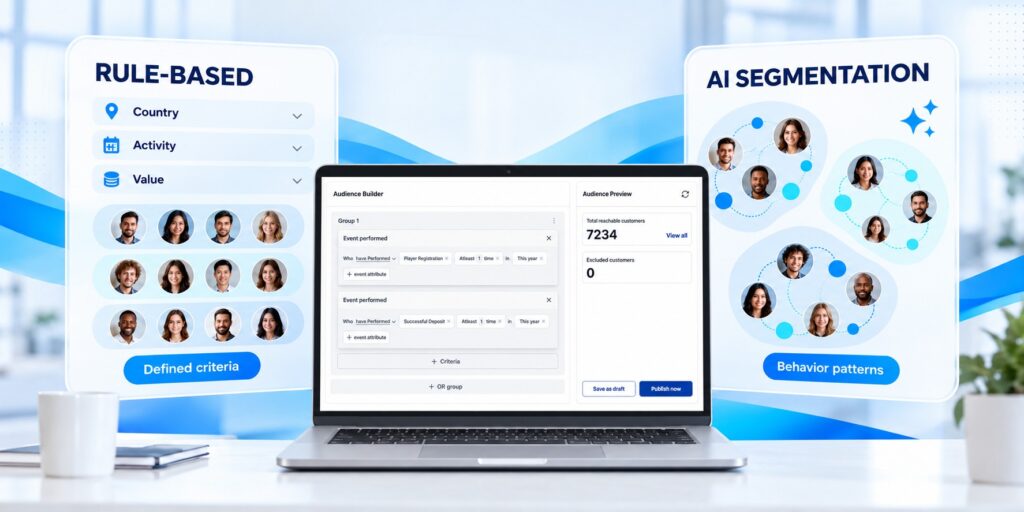
Traditional iGaming marketing automation is usually based on predefined rules.
For example:
If a player has not deposited for seven days and belongs to Segment A, send Campaign B.
That approach remains useful because predictable journeys can run automatically once they have been configured.
A CRM copilot changes the interaction.
Instead of starting with a rule that the marketer must build, the workflow can begin with a question.
For example:
Which high-value players are showing a noticeable decline in deposit frequency compared with their previous behaviour?
The copilot helps investigate the situation first.
Once the opportunity is understood, the CRM team can decide whether that insight should become a segment, campaign, or automated journey.
4. How a Copilot Changes the Retention Workflow Step by Step
The biggest benefit of a copilot becomes clearer when the same traditional retention workflow is repeated with AI inside the CRM.
Ask Instead of Query
The workflow starts with the CRM manager asking a question.
For example:
“Show me high-value casino players whose deposit frequency has dropped during the last 14 days.”
Instead of translating that request into SQL or sending it to another team, the copilot interprets the question and returns the relevant data.
The CRM manager can then refine the question conversationally.
They might ask:
“Only show players who were active at least twice a week during the previous month.”
Or:
“Exclude players who already received a reactivation campaign this week.”
This conversational process makes investigation much faster because the marketer can explore the data without repeatedly starting a new reporting workflow.
Player Segmentation in Minutes
Once the team understands the behaviour, the next step is player segmentation.
Traditionally, this might involve recreating the same logic inside a segmentation interface.
With a copilot, the segment can be created from the original question.
The CRM manager should still be able to see the rules behind the segment.
That transparency is important.
If the copilot creates an audience containing players who have not deposited for 14 days, previously deposited at least twice per week, and belong to a defined value group, those conditions should remain visible and editable.
AI should make segmentation faster without turning the logic into a black box.
The team needs to understand why each player belongs to the audience.
From Segment to Campaign
Creating the segment solves only part of the retention problem.
The team still needs to decide what to do with it.
A CRM copilot can help prepare the next step by suggesting an appropriate channel, timing, message direction, or campaign structure based on the audience being examined.
For example, the copilot may suggest separating high-value players from lower-value players rather than sending one identical promotion to the entire inactive audience.
The CRM manager remains responsible for reviewing that recommendation.
They can adjust the message, remove an unnecessary bonus, change the timing, or decide that some players should not receive a campaign at all.
The value comes from reducing preparation time while keeping the decision with the team.
Reporting Without the Spreadsheet
After the campaign runs, the CRM manager can return to the same conversational workflow.
Instead of exporting campaign data and creating another report, the team could ask:
“How did the reactivation segment perform?”
The next question might be:
“Which player group generated the strongest deposit recovery?”
Then:
“How did players who received the campaign compare with similar inactive players?”
The interaction turns reporting into a continuation of the original workflow rather than a separate analytics project.
Traditional CRM Workflow vs CRM Copilot Workflow
| Step | Traditional Workflow | With a CRM Copilot |
|---|---|---|
| Identify a problem | Review dashboards manually | Ask the CRM a question |
| Find player data | Build a report or request analysis | Receive relevant data conversationally |
| Create segment | Rebuild filters manually | Generate the audience from the question |
| Plan campaign | Configure everything from scratch | Start with AI-assisted recommendations |
| Launch | CRM team reviews and sends | CRM team reviews and sends |
| Analyse results | Export data and prepare reports | Ask follow-up questions inside the |
Predicting Churn Before It Happens
The most valuable retention campaign may be the one that starts before a player fully disengages.
Player churn rarely appears as one universal signal.
For one player, declining deposit frequency may be significant. For another, shorter sessions may indicate reduced engagement. Other signals can include changes in bet size, lower visit frequency, or activity becoming heavily dependent on bonuses.
Looking at one metric in isolation can therefore be misleading.
Churn prediction becomes more useful when multiple behavioural signals are evaluated together.
Churn Prediction in iGaming: The Signals That Matter
Examples of behaviour worth investigating include:
- Deposit frequency declining compared with the player’s normal pattern
- Session frequency or session duration falling
- Average bet size changing significantly
- Previously preferred games no longer being played
- Sportsbook activity falling outside major events
- Engagement occurring mainly when a bonus is available
A copilot can make these signals easier for CRM teams to explore.
Rather than waiting until a player reaches a fixed inactivity threshold, the CRM manager can ask which valuable players are displaying unusual behaviour compared with their own previous activity.
This also connects retention with player lifetime value.
Not every inactive player should receive the same level of attention.
Preventing one historically valuable player from churning may be commercially more important than reactivating a large group of players who have demonstrated very limited engagement.
The role of AI is to help the team find those differences faster.
Real AI Retention Use Cases for Casino and Sportsbook Teams
The practical applications of a CRM copilot vary depending on the operator and player journey.
The following scenarios are illustrative examples of how teams could use the workflow.
Casino: Re-engaging Players Based on Game Preference
Situation: A group of previously active casino players has reduced its activity.
Question:
“Which previously active slot players have reduced their sessions during the last two weeks?”
Action:
The CRM manager reviews the segment, checks previous engagement, and prepares personalised communication based on relevant game preferences rather than sending a generic casino bonus.
Casino: Supporting VIP Management
Situation: A valuable player has begun showing signs of declining activity.
Question:
“Show high-value players whose deposit frequency or session activity has fallen significantly from their normal behaviour.”
Action:
The team reviews the players individually and decides whether a personalised VIP interaction is more suitable than an automated campaign.
Sportsbook CRM: Re-engaging Between Major Events
Situation: Players who were highly active around a major tournament are no longer returning regularly.
Question:
“Which players who bet frequently during the last major event have not placed a bet recently?”
Action:
The sportsbook CRM team creates an audience around upcoming relevant events and prepares event-driven communication.
Multi-Brand Operators: Looking Across Brands
Situation: A CRM team manages several brands and wants to understand engagement across the wider portfolio.
Question:
“Show declining high-value players across our brands and group them by recent activity.”
Action:
The team reviews the results in one workflow rather than repeating the analysis separately for every brand.
These examples demonstrate where a copilot becomes especially useful.
It reduces the operational effort required to explore specific retention questions.
What to Look for in an AI-Powered iGaming CRM Platform
Not every AI feature inside an iGaming CRM platform provides the same level of usefulness.
Operators evaluating iGaming CRM software should focus less on whether a platform simply says it uses AI and more on what the AI can actually help the CRM team accomplish.
Real-Time Player Data
The copilot is only as useful as the information available to it.
If the underlying player data is outdated, the recommendation can also become outdated.
Teams should therefore understand how quickly behavioural, campaign, deposit, and engagement data becomes available inside the CRM.
Actions Inside the CRM
Answers alone are not enough.
A useful copilot should help teams move from insight toward operational actions such as creating a segment, preparing a campaign, or reviewing results.
Otherwise, marketers may still need to move the information into another system before doing anything with it.
Human Approval
AI-assisted recommendations should not automatically become player-facing communication without appropriate review.
CRM teams need the ability to inspect segments, edit messages, adjust campaign rules, and decide whether an action should proceed.
Transparent Outputs
If AI creates an audience or recommendation, the team should be able to understand the logic behind it.
Visible filters and editable conditions are far more useful than unexplained outputs.
Multi-Brand Support
Operators managing several properties should consider whether the CRM can analyse behaviour across brands without forcing teams to repeat the same workflow manually.
The best evaluation question is simple:
Does the AI merely answer questions, or does it actually shorten the CRM team’s workflow?
Where Human Judgement Still Matters
A CRM copilot can speed up investigation, segmentation, campaign preparation, and reporting.
It should not remove human judgement from retention strategy.
A CRM manager understands the operator’s commercial objectives, customer relationships, tone of voice, promotional strategy, and broader context surrounding each campaign.
The team also remains responsible for reviewing responsible gambling considerations before deciding whether a player should receive promotional communication.
AI can surface a pattern.
It can suggest a segment.
It can prepare a campaign.
The CRM team still decides whether acting on that recommendation makes sense.
That distinction is important because the objective of a CRM copilot should not be to put retention on autopilot.
It should give the people responsible for retention faster access to the information they need to make better decisions.
AI in iGaming Is Changing the Time Between Insight and Action
The major change created by AI in iGaming is not that CRM teams suddenly have access to player data.
Most operators already have large amounts of data.
The change is how quickly teams can interact with that information.
Instead of moving from a question to an analyst request, then to a report, then to a segment, then to a campaign, a CRM manager can begin with a natural-language question and continue working from the answer.
That makes iGaming player retention less dependent on waiting for information and more focused on deciding what to do with it.
A CRM copilot does not replace the experience of a retention team.
It gives that team a faster way to investigate player behaviour, create meaningful audiences, prepare campaigns, and understand the outcome.
For operators evaluating the next generation of CRM technology, that workflow may ultimately matter more than the AI label itself.
What should operators look for in an AI-powered iGaming CRM?
Operators should evaluate whether the CRM provides timely player data, transparent segmentation logic, actions within the platform, human approval before campaigns are sent, multi-brand capabilities, and understandable AI outputs. The most important question is whether the AI genuinely reduces the time between identifying an opportunity and acting on it.
| Step | Traditional Workflow | With a CRM Copilot |
|---|---|---|
| Identify a problem | Review dashboards manually | Ask the CRM a question |
| Find player data | Build a report or request analysis | Receive relevant data conversationally |
| Create segment | Rebuild filters manually | Generate the audience from the question |
| Plan campaign | Configure everything from scratch | Start with AI-assisted recommendations |
| Launch | CRM team reviews and sends | CRM team reviews and sends |
| Analyse results | Export data and prepare reports | Ask follow-up questions inside the |
The objective should not simply be to send more campaigns.
The objective is to understand which intervention is appropriate for which player and whether that intervention contributes to sustainable value.
That is where a unified player view can connect CRM activity more closely with commercial outcomes.
7. What to Look for in a Single Customer View Platform for iGaming
Not every CRM, CDP or customer data platform is designed around iGaming workflows.
Operators evaluating an iGaming CRM platform should therefore look beyond whether a product simply claims to provide a customer 360.
The more important question is whether the platform can turn fragmented player data into usable retention workflows.
Key capabilities to evaluate include:
Ready-Made iGaming Integrations
Look for integrations with systems such as:
- PAM platforms
- Sportsbook providers
- Casino systems
- Payment providers
- Bonus engines
- Communication channels
The fewer custom connections operators have to maintain, the easier the environment may be to operate over time.
Real-Time Data Synchronisation
Retention teams should not have to wait until tomorrow to respond to something a player did today.
Real-time or near-real-time updates become particularly important for behavioural segmentation and event-triggered campaigns.
A Unified Profile Accessible Across Teams
The profile should be usable beyond the data team.
CRM managers, VIP teams and other authorised users should be able to access the information relevant to their roles.
Segmentation and Campaigns Using the Same Data
A single customer view becomes significantly more useful when the same data can immediately power segments, audiences and automated journeys.
Multi-Brand and Multi-Product Support
Operators running casino, sportsbook or several brands need a customer data architecture capable of handling that complexity.
Responsible Gambling Signals
Relevant restrictions and player protection indicators should be respected when audiences and campaigns are created.
Role-Based Data Access
Different teams require different levels of information.
Access should therefore be controlled according to operational requirements.
These capabilities help turn the SCV from a reporting dashboard into practical customer retention infrastructure.
See Every Player in One View with OptiKPI
Fragmented player data creates fragmented decisions.
When deposits sit in one platform, betting behaviour in another, bonuses somewhere else and campaign engagement inside a separate CRM, retention teams are forced to work with an incomplete picture.
A single customer view changes that.
By bringing player identity, value, behaviour, communication history and relevant risk indicators into one unified customer profile, operators can segment players more accurately, identify changes earlier and create campaigns based on the player’s actual relationship with the brand.
The goal is not simply to collect more data.
It is to make existing data useful.
For iGaming operators, that can mean stronger player retention, more disciplined bonus spending and a clearer connection between CRM activity and NGR.
See your players in one view. Book an OptiKPI demo.
FAQs
A CRM helps teams manage customer communications, campaigns and relationships. A single customer view focuses on unifying information about each player across different systems. When an iGaming CRM includes customer data unification, the unified profile can directly power segmentation, personalisation and automated campaigns.
Which data sources should an iGaming single customer view include?
An iGaming SCV can include PAM and account data, deposits and withdrawals, casino behaviour, sportsbook activity, bonus usage, marketing engagement, support interactions and relevant responsible gambling signals. The exact sources depend on the operator’s products, brands and technology stack.
How does a single customer view improve player retention?
A single customer view helps retention teams understand several behavioural signals together. Instead of looking only at deposits or gameplay, teams can identify patterns such as falling deposit frequency, shorter sessions and declining campaign engagement, then use those signals to build more accurate retention segments.
How does a single customer view help increase NGR?
A single customer view can support NGR by helping operators retain valuable players while improving promotional efficiency. Better targeting can reduce unnecessary bonus distribution, while unified behavioural data helps teams identify which players may benefit from retention or reactivation campaigns.