Not every player who signs up on your platform is worth the same. You already know that. What separates operators who scale from those who stagnate is how quickly they can spot players who will drive disproportionate revenue. And how fast they can act on that intelligence before a competitor does.
The challenge is not finding VIP players after the fact. It is identifying them before they self-select, before they churn, and before they expect to be treated differently.
This guide breaks down the behavioral signals that separate high-value players from the rest of your user base. It also covers how modern iGaming operators use those signals to trigger CRM actions at exactly the right moment.
Why Traditional VIP Identification Falls Short
For years, most operators used a simple formula. Wait for a player to hit a deposit threshold or rack up enough activity. Then flag them for the VIP team. It was reactive, slow, and costly in both missed opportunity and wasted spend on the wrong players.
The problem with threshold-based identification is straightforward. It tells you what already happened, not what is about to happen. A player who has already deposited €5,000 is not a discovery. They are a given. The real edge is identifying the player on Day 3 or Day 7 who is quietly signaling that trajectory before they reach it.
That is where behavioral analytics changes the game.
The 6 Behavioral Signals That Predict a High-Value Player
The most reliable early indicators of a high-value player are not transaction amounts. They are patterns of behavior that tell a detailed story about intent, engagement depth, and long-term value potential.
- Deposit Frequency Over Deposit Size: A player who makes three €100 deposits in a week is more valuable than one who makes a single €300 deposit and goes quiet. Frequency signals habitual behavior. It tells you this player has built your platform into a routine. High-frequency depositors in the first two weeks consistently outperform large one-time depositors in lifetime value.
- Session Length and Return Rate: How long does a player stay per session? How many days in a row do they come back? A player averaging 45-minute sessions with four logins in the first week shows a fundamentally different engagement pattern from someone who played for two hours once. Return rate within the first 72 hours post-registration is one of the strongest leading indicators of long-term retention.
- Game Diversity and Migration Patterns: Players who explore multiple game verticals within their first few sessions are signaling something important. They are not casual one-game visitors. They are looking for an experience. Operators who track game migration patterns early can identify these users and tailor CRM flows to match where the player is showing genuine interest.
- Stake Escalation Behavior: Watch what happens to bet sizes over time, not just where they start. A player who begins at €1 per spin and gradually moves to €10 over two weeks is showing growing comfort and investment in the platform. That trajectory matters far more than absolute stake size at any single point. Escalating stakes combined with consistent sessions is one of the clearest behavioral fingerprints of an emerging VIP.
- Bonus Interaction and Redemption Patterns: How a player interacts with bonuses reveals a lot about engagement quality. High-value players tend to redeem selectively. They pick offers that align with their preferred games and playing style. Bonus abusers redeem everything indiscriminately and disappear. Tracking the ratio of bonus redemption to actual play value is a far more useful signal than simply whether a bonus was claimed.
- Payment Method Sophistication: Players who register with premium payment methods, use e-wallets, or make full deposits immediately after registration are displaying signals of a more experienced, higher-intent player. Payment behavior correlates strongly with player sophistication and long-term value potential.
From Signals to Scores: Building a Predictive VIP Layer
Individual signals are useful. Combined into a scoring model, they become a competitive weapon.
Operators pulling ahead in player value optimization are moving away from manual VIP identification. They are shifting toward automated behavioral scoring. These systems continuously ingest signals, weight them against historical data, and generate a real-time VIP probability score for every active player.
This is where real-time player analytics becomes essential. Acting on a VIP signal within two hours versus two days is not a marginal difference. It often determines whether you retain a player or lose them to a platform that moved faster. Real-time scoring means CRM triggers fire the moment a player’s behavioral profile crosses a defined threshold.
A well-structured scoring model assigns dynamic weights to each behavioral signal. It adjusts those weights based on game vertical. It cross-references incoming behavior against cohort-level patterns from players who followed a similar trajectory. The output is a continuously updated probability score that drives everything downstream.
Turning Detection Into Action
Identifying a high-value player is only half the equation. The other half is what you do with that intelligence in the minutes and hours that follow.
This is where most operators lose value they have already identified. A VIP probability score sitting in a database with no downstream action attached to it is useless. The trigger-action architecture matters enormously.
When a player’s behavioral score crosses a defined threshold, it should automatically trigger a sequenced CRM workflow. Not a generic message, but a personalized outreach that reflects exactly what that player has been doing. If they have been gravitating toward live casino, the offer should be live casino-native. If their sessions peak on weekday evenings, the communication should land at that time.
The leap from detection to activated VIP treatment is where iGaming loyalty and VIP program infrastructure does its heaviest lifting. Detection without an activation layer is just expensive data collection.
The Timing Problem Nobody Talks About
There is a window for VIP intervention that most operators miss entirely.
It opens around Day 5 to Day 10 after registration. Behavioral patterns are consistent enough to be meaningful at this point. But the player has not yet established loyalty to any particular platform. If you are not reaching high-probability VIP players with personalized communication in this window, you are leaving the door open for a competitor who will.
This matters because high-value players are almost always active on more than one platform. They are not shopping for the best bonus. They are shopping for the best experience. The operator that demonstrates early understanding of a player’s preferences wins a disproportionate share of wallet.
Miss the window and you are not just losing a session. You are ceding ground in a relationship that could represent thousands in annual revenue.
What OptiKPI Does Differently
Most CRM platforms tell you what happened yesterday. OptiKPI tells you what a player is likely to do next and triggers the right action before you have to think about it.
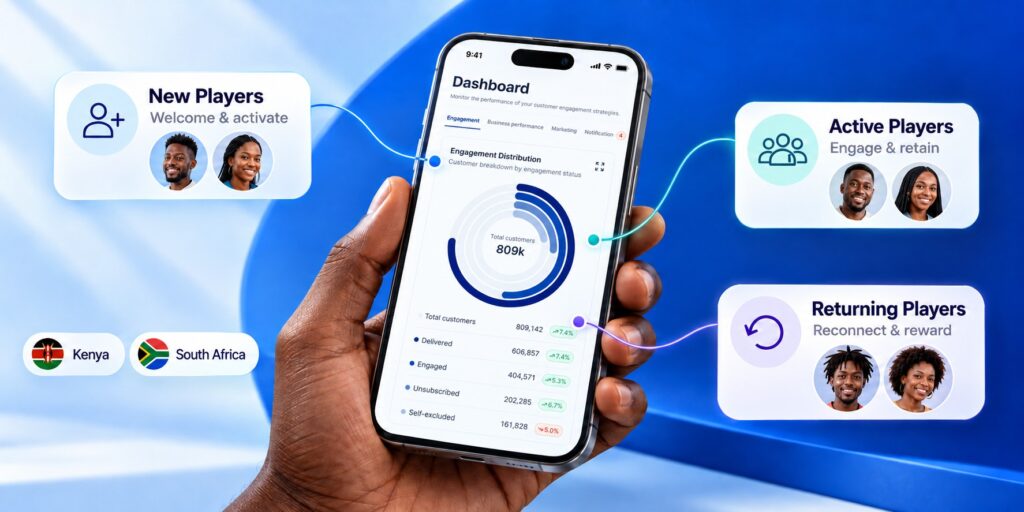
The behavioral scoring engine ingests real-time session data, deposit patterns, game activity, and bonus interaction. It generates continuously updated VIP probability scores for every player. When a score crosses a defined threshold, automated CRM workflows fire immediately. No analyst required. No batch processing delay.
The results are measurable. Ninja Casino achieved a 27.3% uplift in player reactivation by acting on behavioral signals in real time rather than after the fact.
OptiKPI’s VIP detection is embedded into the broader CRM workflow architecture. Identification and activation happen in the same system. There are no data handoff delays and no gaps between signal and action.
The Bottom Line
High-value players do not announce themselves. They leave signals in how often they return, how their stakes evolve, which games they explore, and how they interact with offers. Operators who read those signals accurately and act quickly are the ones who build VIP programs that generate real revenue.
The technology exists. The behavioral framework exists. What separates operators now is whether they are using these tools with enough precision and speed to matter.
If you are still identifying VIPs by looking backward at spend thresholds, you are not identifying them at all. You are just confirming what already happened.
See how OptiKPI’s VIP detection engine works in practice. Book a demo and see real-time behavioral scoring in action.
Frequently Asked Questions
High-value players generate disproportionately higher revenue than the average user. They are identified by consistent deposit frequency, longer sessions, and escalating stake behavior rather than one-time large deposits.
By tracking behavioral signals like return rate within 72 hours, deposit frequency in the first two weeks, and stake escalation. Real-time behavioral scoring flags these players automatically before they appear in revenue reports.
It is the process of separating high-value players from the broader base using behavioral data. It ensures your most valuable players receive personalized CRM treatment at the right time, improving retention and lifetime value.
Deposit frequency, session return rate, game diversity, stake escalation, bonus redemption patterns, and payment method sophistication. Together these signals identify future VIPs days before they hit any spend threshold.
It replaces reactive spend-based identification with real-time behavioral scoring. CRM workflows fire automatically when a player crosses a defined threshold, closing the gap between signal and action.