
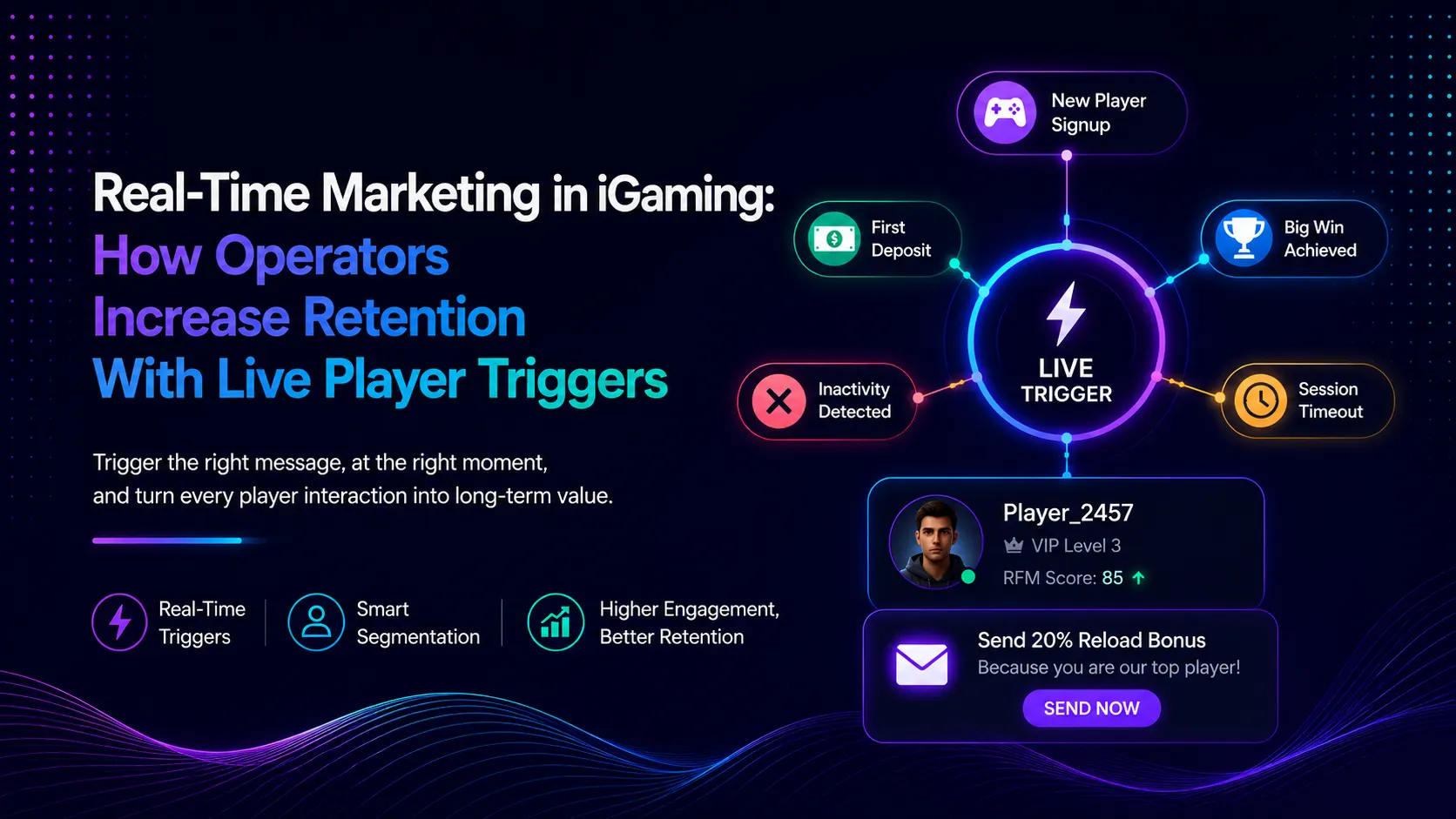
Every operator loses players they could have kept. Not because the offer was wrong — because it arrived too late. A player deposits, plays fifteen rounds, hits a cold streak, and closes the app. Three hours later, a re-engagement email lands. By then, the moment that mattered is gone.
This is the gap real-time marketing in iGaming exists to close. It’s not another word for personalization, and it’s not a synonym for automation. It’s the discipline of acting on player behavior while that behavior is still happening, inside the session, not after it.
What Real-Time Marketing Means in iGaming
Real-time marketing in iGaming is the practice of detecting a player action and triggering a response within seconds or minutes, not hours or days. A player’s behavior, a deposit, a losing streak, a session on a specific game, an abandoned cart on a deposit page, becomes the input. The output is an immediate, relevant nudge: a bonus, a message, a game recommendation, a loyalty prompt.
This is different from segmentation-based marketing, which groups players by historical patterns and sends campaigns on a schedule. Real-time marketing works on live signals. It asks “what is this player doing right now” instead of “what did players like this one do last month.”
For operators running casino and sportsbook products, this distinction matters because player behavior inside a session is volatile. A player who is engaged at minute five can be disengaged by minute twenty. This is the layer that catches that shift while there’s still time to respond to it the core of genuine real-time player engagement.
Why Delayed Campaigns Fail in Online Casino and Sportsbook Marketing
Delay is the single biggest silent cost in retention marketing. Most CRM stacks are built around batch processing, data is collected, processed overnight, and campaigns go out the next day. By the time a “we miss you” email reaches a player who churned yesterday, the emotional and behavioral context that caused the churn has already faded.
Three specific failure patterns show up repeatedly:
- The cold-streak drop-off: A player hits a losing run, exits the session, and never gets a same-day signal that acknowledges it. A next-day bonus email reads as generic rather than responsive.
- The abandoned deposit: A player starts a deposit flow, hesitates, and exits. Without a real-time nudge, that hesitation becomes permanent churn instead of a recoverable moment.
- The dormant high-value player: A VIP who typically plays three times a week goes quiet for four days. Batch-based systems flag this a week later, well past the point where a timely gesture would have brought them back.
In sportsbook specifically, timing failures are even more visible. A live betting market closes, a favorite team loses, or a big win goes unacknowledged, and the operator’s next communication is a scheduled promo that has nothing to do with what just happened. Sportsbook players notice this disconnect faster than casino players because sports events are public and time-bound; a message that ignores the game that just ended feels out of touch.
The Real-Time Player Behaviors Operators Must Track
Not every player action deserves a real-time response. Effective behavioral marketing in iGaming depends on tracking a focused set of behaviors that reliably predict churn risk or engagement opportunity:
- Session velocity changes: A sudden increase or decrease in bet size or spin frequency within a single session
- Deposit funnel hesitation: Time spent on a deposit page without completing the transaction
- Loss sequences: A consecutive losses that historically precede session exit
- Game-switching behavior: A rapid movement between games, often a sign of disengagement
- Win spikes: A large win that creates a natural moment for a loyalty or reload prompt
- Idle time within an active session: A player logged in but inactive for an unusual stretch
- Cash-out or withdrawal initiation: A signal worth monitoring for VIP retention conversations
- First-time actions: A new player trying a game vertical (e.g., moving from slots to live dealer) for the first time
The operators who get real-time marketing right aren’t tracking everything. They’re tracking the handful of behaviors that have a demonstrated relationship to retention outcomes, and building trigger logic specifically around those.
High-Impact Real-Time Marketing Triggers That Increase Retention
Behavior tracking only creates value once it’s connected to action. These are the triggers that consistently move retention numbers when implemented well:
- Loss-sequence recovery trigger: After a defined number of consecutive losses, deliver a low-friction gesture, free spins, a small cashback nudge, or a supportive message, before the player exits the session.
- Deposit-hesitation trigger: When a player spends longer than expected on a deposit page without completing it, surface a first-deposit bonus reminder or a simplified payment option in real time.
- Win-moment trigger: Immediately after a significant win, prompt a loyalty tier update, a “lock in your win” reload offer, or a cross-sell into a related game category.
- Session re-entry trigger: If a player exits mid-session during a losing streak, schedule a short-delay message (same day, not same week) referencing something specific to that session rather than a generic reactivation offer.
- VIP dormancy trigger: For high-value players, a shortened dormancy window (24–48 hours instead of the standard 5–7 days) triggers a personal outreach or exclusive offer before the player fully disengages.
- Cross-vertical trigger: When a player who typically plays slots places their first sportsbook bet, or vice versa, trigger a targeted onboarding sequence for that new vertical while the curiosity is still active.
Each of these triggers works because it closes the gap between the behavior and the response as part of a broader player retention marketing strategy. The value isn’t in the offer itself, it’s in the timing.
How Live Segmentation Improves Campaign Performance
Traditional segmentation sorts players into groups based on historical data: lifetime value, game preference, deposit frequency. Live segmentation adds a real-time layer on top of that structure, it re-evaluates a player’s segment based on what they’re doing right now, not just what they’ve done historically.
A player classified as “low-risk, high-value” in a static segmentation model can shift into a “high churn-risk” state mid-session because of a loss sequence or a failed deposit attempt. Live segmentation catches that shift immediately, which means the campaign engine can respond to the player’s current state instead of a state that was accurate a week ago.
This matters operationally because static segments update on a schedule, often daily or weekly while player state changes in minutes. Operators running live segmentation alongside behavioral triggers see meaningfully better campaign performance because the message matches the player’s actual condition at the moment of delivery, not their average condition over the past month.
Real-Time Marketing Use Cases Across Casino, Sportsbook, and VIP Segments
- Casino: A slots player on a losing streak gets a same-session free-spin trigger before frustration turns into exit. A live dealer player who’s been at the table for over 40 minutes without a break gets a subtle table-switch recommendation to sustain engagement rather than fatigue.
- Sportsbook: A player whose pre-match bet loses gets an in-play cross-sell into a live betting market on the same event, keeping engagement active within the same event window rather than losing the player until the next fixture.
- VIP: A VIP player’s session length drops 30% below their rolling average — a real-time flag routes this to a VIP account manager for same-day personal outreach, rather than waiting for a weekly VIP report to surface the change.
Across all three, the pattern is identical: behavior happens, the system detects it inside a narrow window, and the response lands while the context is still relevant to the player.
Quick Wins vs Structural Fixes in Real-Time CRM Execution
Operators evaluating iGaming CRM automation often ask where to start. There’s a meaningful difference between quick wins and structural fixes, and conflating the two slows implementation down.
Quick wins are single triggers layered onto an existing CRM stack — a loss-sequence bonus trigger, a deposit-abandonment nudge. These can be live within weeks and produce measurable retention lift almost immediately, because they address an obvious, high-frequency gap.
Structural fixes involve rebuilding the data pipeline so player behavior streams into the CRM in real time rather than in batches. This is a bigger lift — it usually means integrating event-level data feeds, rebuilding segmentation logic to run continuously, and reworking campaign orchestration to support trigger-based sends instead of scheduled ones.
The mistake many operators make is trying to solve the structural problem before capturing the quick wins, which delays value for months. The more effective sequence is to launch two or three high-impact triggers on existing infrastructure first, prove the retention lift, and use that as the business case for the structural rebuild.
Common Failures in Real-Time iGaming Campaigns
Even operators who invest in real-time infrastructure run into recurring execution problems:
- Trigger overload: Too many triggers firing on the same player creates message fatigue instead of engagement. A player getting three real-time nudges in one session tunes all of them out.
- Missing suppression logic: Without rules to prevent overlapping triggers, players can receive contradictory messages — a reload offer right after a “cool-down” responsible gambling nudge, for example.
- Latency creep: Systems billed as “real-time” that actually run on 30–60 minute batch cycles miss the window that makes the trigger valuable in the first place. A loss-sequence trigger that arrives an hour after the player has already left the session behaves exactly like a delayed campaign.
- No feedback loop: Triggers get built once and never re-evaluated against actual retention outcomes, so underperforming triggers keep firing indefinitely while better ones never get tested.
- Compliance blind spots: Real-time triggers tied to loss sequences or deposit behavior need to be built with responsible gambling thresholds in mind from the start — retrofitting compliance logic after launch is far harder than designing for it upfront.
Building a Real-Time Marketing Workflow With CRM Automation
A working iGaming campaign automation workflow follows a consistent sequence: behavior → trigger → action → outcome.
Take the loss-sequence example end to end:
- Behavior — a player logs four consecutive losses within a single session.
- Trigger — the CRM’s behavioral engine flags this in real time against a pre-set threshold.
- Action — a low-friction, compliance-checked offer (free spins or a small cashback gesture) is delivered instantly, in-session.
- Outcome — session length and next-day return rate are tracked against a control group that didn’t receive the trigger, feeding back into whether the trigger threshold needs adjustment.
This is where iGaming CRM automation earns its place not as a broadcast tool, but as the orchestration layer that connects live behavioral data to compliant, timely action without manual intervention. Operators running this loop well treat it as a continuously improving system: triggers get refined based on what actually moves retention, not left running on assumptions from launch.
How OptiKPI Helps Operators Activate Real-Time Retention Campaigns
Building this kind of workflow from scratch — live behavioral tracking, trigger orchestration, and compliant automated action — is a significant lift for most internal marketing and CRM teams. OptiKPI is built specifically for this layer of iGaming retention: it ingests player behavior in real time, applies configurable trigger logic across loss sequences, deposit hesitation, dormancy windows, and win moments, and activates the right action the moment the behavior happens.
Rather than replacing an operator’s existing CRM stack, OptiKPI sits on top of live player data to close the gap between signal and engagement — the exact gap that makes delayed campaigns underperform. For operators looking to move from scheduled, batch-based retention marketing to a real-time model, this is the infrastructure layer that makes it operationally possible without a full rebuild.
FAQs
Real-time marketing in iGaming is the practice of detecting player behavior — such as a deposit, a loss sequence, or a win — and triggering a relevant marketing response within seconds or minutes, while the player is still active, rather than through a scheduled campaign sent hours or days later.
Player state changes quickly within a session — a player can shift from engaged to disengaged in minutes. Responding to that shift in real time captures moments of churn risk or opportunity that a delayed, scheduled campaign will always miss.
The highest-value behaviors include loss sequences, deposit-page hesitation, session velocity changes, win spikes, idle time within an active session, and dormancy shifts among VIP players — all of which have a demonstrated link to retention outcomes.
It removes the delay between a player’s action and the operator’s response, so offers and messages land while the behavioral context is still relevant. This closes the gap that causes players to churn between the moment they disengage and the moment a delayed campaign eventually reaches them.
Examples include a free-spin trigger after a losing streak, an in-play cross-sell after a sportsbook bet loses, a deposit-abandonment nudge on payment pages, and same-day VIP outreach triggered by an unusual drop in session activity.