Most iGaming operators are sitting on enormous amounts of player data. The real question isn’t whether you have data it’s whether you’re seeing it in time to act on it.
Batch reporting, daily dashboards, and weekly CRM summaries have served the industry for years. But in a market where player decisions happen in seconds, a session abandoned, a deposit reconsidered, a competitor’s offer accepted that lag is costing you revenue.
Real-time player analytics changes the equation. Instead of learning what happened yesterday, you see what’s happening now. And more critically, you see who is becoming valuable before they raise their hand.
This post is specifically about two things: what live data actually surfaces for operators, and how that live data identifies high-value players before they self-select. Everything else segmentation frameworks, CRM automation, VIP program design is covered in depth across our related content.
The Gap Between Data and Decision-Making in iGaming
The average iGaming operator processes more player events in a single hour than most industries do in a day. Game rounds, deposits, withdrawals, bonus claims, session starts, support contacts the volume is staggering.
Yet the operational model in much of the industry still treats this data as something to be reviewed rather than acted upon. Reports are generated. Teams review them. Campaigns are planned. By the time a relevant action reaches a player, their moment has passed.
This creates a compounding problem. The players who represent your highest lifetime value aren’t the ones who will wait. They play across multiple platforms. They respond to relevance and timing. A message that arrives 18 hours after a trigger event doesn’t feel like care it feels like noise.
Real-time player analytics is the infrastructure that closes this gap. It’s not a reporting upgrade. It’s a fundamental shift in how operators relate to player behavior as it unfolds.
What Real-Time Casino Analytics Actually Shows You
When operators talk about real-time analytics, they often mean dashboards that refresh every few minutes. That’s a start, but it’s not the same as genuinely live visibility. True real-time casino analytics gives you event-level data as it happens not aggregated, not delayed, not sampled.
Here’s what that actually looks like in practice:
Live Session Behavior
You can see which players are active, what they’re playing, how long they’ve been in session, and whether their behavior is consistent with their historical pattern. A player who normally plays for 45 minutes but has been in session for two and a half hours is giving you a signal and that signal has value right now, not tomorrow morning.
Deposit and Withdrawal Velocity
Real-time financial data doesn’t just tell you amounts it tells you pace. A player making their third deposit within a single session looks very different from a player who deposits once weekly. That real-time velocity is a high-value indicator that disappears entirely in daily summary data.
Game and Category Switching
When a player moves between game categories mid-session from slots to live casino, or from casual games to higher-stakes tables that shift in behavior is immediately visible. It often signals an evolving player preference that, if recognized and responded to, can significantly increase engagement depth.
Bonus and Promotion Response
Real-time analytics shows you not just whether a player claimed an offer, but how quickly they claimed it, what they did immediately afterward, and whether their next session behavior changed. This is the difference between knowing a promotion was used and understanding whether it actually worked.
How Live Data Identifies High-Value Players Before They Self-Select
This is where real-time analytics delivers its most commercially significant advantage and where the distinction from historical reporting is sharpest.
Traditional player value models work retrospectively. A player accumulates activity over weeks or months, crosses a threshold, and gets escalated to VIP status. By the time you recognize them, they’ve already demonstrated their value often without receiving any differentiated treatment during the phase when their behavior was actually forming.
Real-time data creates a different model: predictive identification based on behavioral signals that appear early in the player lifecycle.
The Signals That Appear Before Value is Confirmed
High-value players rarely announce themselves. But their behavior in the first days and sessions of activity tends to follow patterns that are identifiable in real time:
- Rapid return frequency a player who completes a session and returns within hours, rather than days, is showing engagement intensity that correlates strongly with higher long-term value.
- Stake escalation within sessions players who progressively increase their stake size within a single session, rather than maintaining flat bet patterns, are demonstrating confidence and commitment that distinguishes recreational players from higher-value ones.
- Multi-product engagement a player who explores live casino, sports betting, and slots within their first week of activity is showing platform breadth that high-value players consistently exhibit.
- Unsolicited high deposits a player who deposits significantly more than their initial transaction, without any promotional prompt, is one of the clearest early signals of genuine high-value intent.
None of these signals exist in a batch report. They appear and pass within hours. An operator with real-time visibility can act on them immediately. An operator reviewing yesterday’s data has already missed the window.
The strategic implication is significant. When you identify a potentially high-value player in real time before they’ve committed long-term loyalty to your platform your ability to shape their experience, and therefore their trajectory, is at its highest.
The Player Monitoring Dashboard: From Visibility to Action
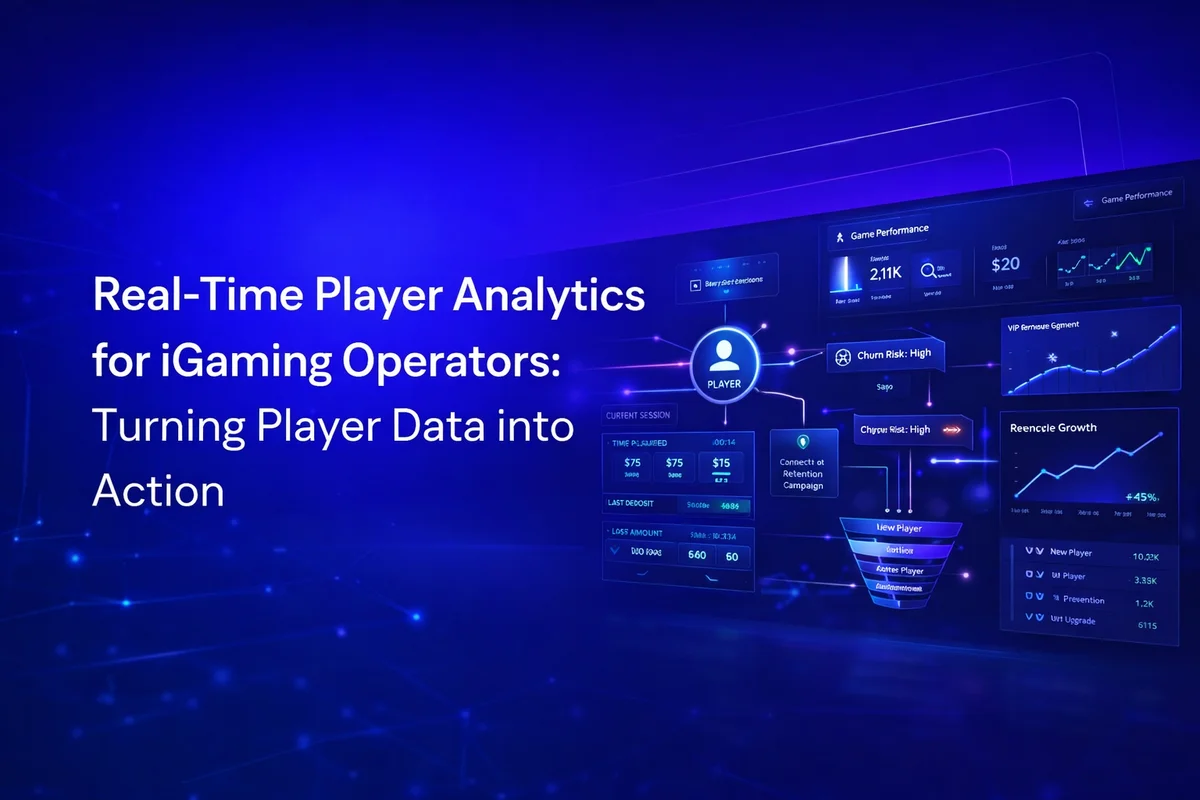
A real-time analytics capability is only as useful as its ability to translate visibility into operational action. Data that sits in a dashboard without triggering a response is just information. The operational value comes from connecting the live signal to an immediate response.
The most effective player monitoring dashboards in iGaming are built around a core principle: every significant player event should be capable of triggering a defined response, whether automated or manual. This means:
- Retention teams can see which currently-active players are exhibiting early disengagement signals and intervene before the session ends.
- CRM managers can identify players who crossed a value threshold in the last hour and route them to an appropriate experience immediately.
- VIP teams can receive automatic alerts when a player’s in-session behavior matches the early-stage profile of their existing high-value cohort.
The connection between real-time detection and VIP-level response is one of the most commercially impactful use cases for live player analytics. For more on what happens once a player is identified and how to structure that follow-up experience, see our guide to iGaming loyalty and VIP program strategy.
Why Most iGaming Analytics Platforms Fall Short on Real-Time
The iGaming analytics platform market has grown significantly, but real-time capability remains genuinely differentiated. Most platforms offer one or more of the following but not all three:
- Historical reporting with rich segmentation and cohort analysis
- Near-real-time dashboards (5–30 minute refresh cycles)
- Campaign automation tied to pre-defined rule triggers
Genuine real-time analytics event-level visibility with sub-minute latency and the ability to trigger both automated and manual responses requires a fundamentally different data architecture. It means event streaming, not batch processing. It means a data pipeline built for iGaming transaction volumes specifically, not repurposed from general-purpose BI tools.
This distinction matters operationally. A platform that refreshes every 15 minutes will miss the early high-value signals described above almost entirely. The window is narrower than that.
How OptiKPI Delivers Real-Time Player Analytics for iGaming Operators
OptiKPI is built specifically for iGaming operators who need to act on player data at the speed the industry actually operates. The platform is architected around real-time event streaming, which means player behavior is surfaced as it happens not after processing delays or scheduled batch jobs.
Live Player Monitoring
OptiKPI’s player monitoring dashboard gives retention and CRM teams visibility into active player behavior across sessions, games, deposits, and promotional interactions in real time. Teams can configure alerts for the specific behavioral signals that matter to their operation, from deposit velocity to session duration anomalies.
Early High-Value Player Detection
The platform is designed to surface players who match high-value behavioral patterns as those patterns emerge not after they’ve been confirmed over weeks of accumulated data. This gives operators a meaningful window to shape the player experience during the period when it’s most influential.
Action-Ready Data Architecture
Real-time visibility in OptiKPI isn’t passive. Every signal surfaced through the iGaming analytics platform can be connected to automated responses campaign triggers, bonus allocations, VIP escalation workflows, and direct retention interventions. The platform is built so that what you see can immediately become what you do.
Ninja Casino used OptiKPI’s real-time data infrastructure to achieve a 27.3% uplift in player reactivation a result that required both the live signal capability and the ability to act on it immediately. Read the full Ninja Casino case study to see how real-time analytics translated into measurable reactivation performance.
The Competitive Case for Real-Time: Timing is Differentiation
The iGaming market is one of the most retention-challenged industries in digital commerce. Acquisition is expensive. Player loyalty is fragile. The operators who build sustainable revenue do so by extracting more value from the players they already have and by identifying which players are worth investing in before competitors do.
Real-time player analytics is the infrastructure that makes this possible. It is not a feature on top of an analytics stack it is the foundation that makes every other player management capability faster and more precise.
Consider what real-time data enables that batch reporting cannot:
- Intervening during a session, not after it ends
- Reaching a player at peak engagement rather than hours later when attention has moved elsewhere
- Identifying an emerging high-value player before they’ve committed loyalty to a platform
- Responding to a withdrawal attempt with a relevant retention offer before the player leaves the session
Each of these moments is time-bounded. Real-time analytics is the only infrastructure that puts operators inside those windows.
What to Look for in a Real-Time iGaming Analytics Platform
If you’re evaluating iGaming data analytics platforms for real-time capability, the following criteria separate genuine real-time infrastructure from near-real-time approximations:
- Data latency what is the actual delay between a player event and its appearance in the dashboard? Anything above 60 seconds means you’re missing critical in-session signals.
- Event granularity does the platform show you individual events (a single game round, a deposit, a session start) or only aggregated summaries? Granular data is essential for early high-value player identification.
- Alert and trigger architecture can you configure automated responses to specific player events as they occur? Or does the platform only support scheduled campaign logic?
- iGaming-native data pipeline is the platform built to handle iGaming transaction volumes, or is it a general analytics tool with iGaming integrations layered on top? The architecture difference is significant at scale.
- Operator access and control can your CRM, retention, and VIP teams access real-time signals directly? Or does live data require technical resource involvement to surface?
Real-Time Is Not a Feature: It Is the Foundation
The iGaming operators who consistently outperform on retention and revenue share two characteristics: they know what their players are doing right now, and they have the infrastructure to respond immediately.
Real-time player analytics is not the final piece of a sophisticated operator stack. It is the foundation that makes every other capability CRM automation, VIP identification, retention intervention, behavioral targeting operate at the speed the market demands.
If your current analytics infrastructure is still operating on batch cycles, you are not behind on a tool you are behind on timing. And in iGaming, timing is the primary competitive variable.
See how OptiKPI’s real-time iGaming analytics platform works in practice book a demo or see the platform in action today.
FAQs
Real-time player analytics gives operators live visibility into sessions, deposits, game switches, and bonus responses as they happen. Unlike batch reporting, data arrives with sub-minute latency. That means operators can act within the same session, not the following day.
Live data surfaces early signals like rapid return frequency, stake escalation, and unsolicited high deposits. These patterns confirm high-value intent before weeks of history accumulate. Operators who catch them immediately can shape the player experience while loyalty is still forming.
A genuine real-time iGaming analytics platform needs event-level data, configurable behavioral alerts, and automated triggers tied to live player events. Refresh cycles of 15 minutes or more will miss critical in-session signals. Platforms built on general-purpose BI tools typically cannot meet these requirements at iGaming transaction volumes.
A player monitoring dashboard shows who is active, what they are doing, and whether their behavior is deviating from their normal pattern. Retention teams can use that visibility to intervene before a session ends. Standard reporting tools only confirm what already happened.
Real-time player behavioral analytics allows operators to detect disengagement signals mid-session and trigger a retention response immediately. An offer delivered during an at-risk session consistently outperforms one sent hours later. By then, the player has already left.